Friday Fun: More About the Unofficial #DrinkingSIG

Last Friday Fun I briefly mentioned the unofficial Drinking SIG of MLA, this Friday Heather Holmes also known as @LaMedBoheme73 on Twitter and #DrinkingSIG Convener, wrote a more in depth guest post that I thought would be fun to share.

*BTW as Heather mentions you don’t have to drink alcohol. I’m living proof, because I remember being pregnant one year sipping away at my Coke.


What is the (unofficial and not at all sanctioned by) MLA, #DrinkingSIG?
Heather N. Holmes, MLIS, AHIP
#DrinkingSIG Convener
@LaMedBoheme73

The MLA #DrinkingSIG came about a few years ago prior to the MLA annual meeting in Minneapolis. There was twitter banter about social activities to take place after the day’s events were over and the #DrinkingSIG was born. Key players in the (very) early discussions were myself, @krafty, @deanhendrix, @eagledawg and @gabinator, and from there many others joined in. Since then it has become something that many of us formally add to our schedules as something to do while at MLA.

 To be clear, just because we call it the #DrinkingSIG, we do not exclude anyone. You do not have to consume alcohol of any sort. We assume that even if you don’t booze it up drink alcohol, you probably drink water, tea, Pepsi, or something. See what I did there? Just by ‘drinking’ you qualify for #DrinkingSIG membership. Our intention is to get together with old friends and hopefully make some new ones, too. It is a chance to unwind after long and sometimes stressful days, and to network with your colleagues while rehydrating* your body.

Last year (2012) was the first year we made it a little more formal when I introduced the idea of opening a CafePress shop to sell #DrinkingSIG merchandise and have the profits go to the MLA Scholarship Fund. The shop offered tshirts and umm, obviously, drinkware like pint glasses and shot glasses. This year’s shop includes some more drink related products like can cozies, a cocktail shaker, and of course a flask. There’s also a small flask on a necklace. It is only 1oz, but as @eagledawg said on my Facebook page: “Flask. Necklace. 1oz isn’t enough, you say? Remember those consecutive 7am committee and business meetings you have to go to? ‘Cream’ for your coffee = Bailey’s. ‘Nuff said. ” The logo on this year’s products says One Hooch: It’s Always Happy Hour Somewhere! MLA Annual Meeting, Boston, MA, 2013 accompanied by a picture of a few of my own personal drinking vessels (copyright issues avoided). The theme was a combination of submissions by Molly Knapp and Heather Brown. Special thanks to them.
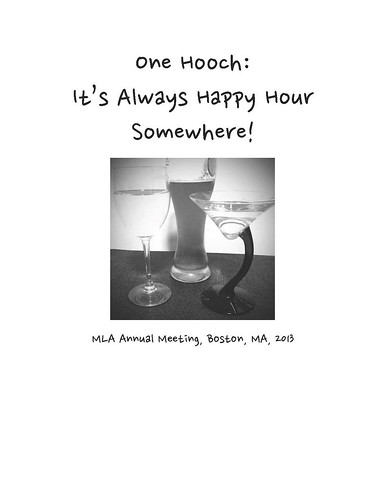
drinkingsig

The only problem with CafePress is that they don’t issue payment of profits to you until you reach a certain amount. To keep things reasonable (read: most librarians are poor) I haven’t added a huge markup up the products so I have yet to make a donation to MLA on behalf of the #DrinkingSIG, but hopefully we’ll make enough this year that I can do so. I’d like our first donation to be at least $50. Right now I have about $22.

This year’s meeting does not have a Tweetup scheduled so we will make one with an official (but not sanctioned by MLA!) #DrinkingSIG meetup. Probably a good time to have it would be during @TheBeardedPigs event on Sunday night. The EBSCO party is also that night, but The Pigs usually play relatively late and the EBSCO event is within walking distance so people who want to do both won’t be stuck waiting for a bus to bring them back. Another possibility could be on Tuesday after Tech Trends. The Taste of Boston party is also that night, but for those of us who couldn’t shell out the extra $ to go to it, can have a #DrinkingSIG event somewhere. Plus, I’m a panelist on this year’s Tech Trends and I’ll definitely need a drink afterward. Also, it can be considered a #DrinkingSIG event any time that 2 or more MLA members are drinking together. They can happen any time, any where!

 Go to the CafePress shop, get some gear so we can make some profit, and we’ll see you at MLA in Boston!

 *some drinks rehydrate better than others. All members are encouraged to drink plenty of water before, during, and after #DrinkingSIG events.

 http://www.cafepress.com/DrinkingSIG

See the Midwest Chapter Members Presenting at MLA

The ConnectMidwest blog has a list of Midwest Chapter members presenting at MLA in Boston.  Very busy group of people, scroll through it and see what your colleagues are doing or have done.

The Midwest Chapter is also looking for a blogger or two who would like to post about the conference for the MidwestConnect blog so non attendees can keep up.  If you are interested send Elizabeth Moreton a email. emoreto[at sign] siue [that dot thing] edu.

Updates on Edwin Mellen Press lawsuits

Another layer has been added to the issues surrounding the Edwin Mellen Press lawsuits.  Last week Scholarly Kitchen published a post explaining they removed two posts (and comments) by Rick Anderson discussing Edwin Mellen Press because they received letters from EMP threatening legal action. The letter tells Scholarly Kitchen, “We are putting you on notice that the moment Mr. Anderson publishes or provokes any statement about our company or authors that is the slightest bit defamatory, we will pursue legal action only against him, but your organization as well.”

Here is the full letter to Scholary Kitchen about Rick Anderson.  It also appears that Edwin Mellen Press is also holding Scholarly Kitchen liable for libelous comments made by the general readership.  Because in their Rick Anderson letter they also mention they enclosed a copy of a letter  to Kristine Hunt, who they claim posted libelous statements in response to Anderson’s blog.  EMP’s Anderson letter says, “We are bringing this information to your attention because you are the publishers of both Ms. Hunt’s statement and Mr. Anderson’s blog. As such, you have a legal obligation to monitor these types of comments. In order to limit any damage from such events, we request the immediate removal of Ms. Hunt’s comments from your blog.”

The letter to Kristin Hunt specifically states that EMP takes issue with two comments she made on Anderson’s post that they believe are harmful and untrue.  Their letter ends, “You have the right to seek legal counsel pertaining to this matter and, if you do so, your attorney should contact me directly.  If you do not consult an attorney, you are welcome to contact me yourself.  If I do not hear from you or your attorney by April 15, 2013, the Press will take legal action as it sees fit.”

Yikes! But there is more.

Roy Tennant with The Digital Shift published on Friday that Edwin Mellen Press registered domain names using Dale Askey’s name (Askey, to my knowledge, is still battling one of the two lawsuits brought by EMP).  Roy has the registration record  as an in the post showing DALEASKEY.COM registered to Edwin Mellen Press Ltd. address and has Iona Williams with an EMP email address as the administrative contact.

Dave Pattern mentions in the comments, that many sites (besides the Dale Askey ones) were registered by “pseudonymous  ‘Arthur Scholar’ (pen name of the blogger on the EMP site & also the EMP tweeter) has been used to register around 100 domains over the years.”  He says Iona (Margaret) Williams registered some other mellenpress domains and is listed as a contact on Mellen’s website and as a Secretary for the company at these two places

  • http://bit.ly/XSDvd0
  • http://bit.ly/Z3GbUz


I agree with Dave, in which I have no idea why anyone or any company would want to buy domain names that aren’t related to themselves.  Weird, and just to let my readers know. This is not an April Fool’s post.

(Total side note and apology to Rick Anderson, I can’t help it but every time I read the EMP letter all I can hear is Agent Smith (Hugo Weaving) in the Matrix saying “Mr Anderson.” I bet there are times Rick and Dale wish they took the blue pill.)


Friday Fun: The Unofficial MLA Drinking SIG

Many who go to MLA often find themselves in the evening after the meeting going out to dinner and the bars to discuss library and non-library stuff.  I remember somebody mentioning that we met for drinks so often that we could have our buisness meetings at the bar.  After a good laugh and a few more drinks later the unofficial Drinking SIG was born. 

I want to stress it is all in good fun and completely unofficial from MLA.  There are no dues but you will probably have a bar bill.  Last year was the first year the unofficial Drinking SIG came off of the barstool and started selling t-shirts and other fun items promoting the group.  This year for 2013 a new design and new set of items is available http://www.cafepress.com/drinkingsig for you to purchase. 

Even though the SIG is not official, it wouldn’t exist without the people of who attend MLA.  So all of the profits from the SIG’s cafepress site sold will go to the MLA scholarship fund. 

Next Friday Fun post will be a guest post from Heather Holmes about the unofficial Drinking SIG.

JLA Editorial Board Resigns Due To Taylor Francis Copyright Issue

According to The Chronicle of Higher Education, Wired Campus,  the editor and entire editorial board of the Journal of Library Administration resigned in response to a conflict with the Taylor & Francis author agreement that the board believed was “too restrictive and out fo step with the expectation of authors.”

Damon Jaggers told The Chronicle that the Taylor Francis author agreement and licensing terms scared potential authors away making it difficult to attract quality authors.  Not only was this a problem for potential authors but even a member of the editorial board who was was concerned about publishing and licensing. 

In the blog post, The Journal of Library Administration, Jason Griffey describes his concerns in detail after reading the Taylor & Francis author agreeement sent to him by Brian Mathews (guest editor for special issue of the journal).

I’ll be blunt: there is no situation in which I’d sign copyright over the T&F…or, frankly, anyone. I’m very happy to sign a license of limited exclusivity (say, 30-90 days) for publication, or license the work generally under a CC license and give T&F a specific exemption on NC so they can publish it. But their language about “Our belief is that the assignment of copyright in an article by the author to us or to the proprietor of a journal on whose behalf we publish remains the best course of action for proprietor and author alike, as assignment allows Taylor & Francis, without ambiguity, to assure the integrity of the Version of Scholarly Record, founded on rigorous and independent peer review. ” is just…well, bollocks.

According to a post from Chris Bourg (an editor for JLA), Jaggers tried to work with Taylor & Francis on their licensing terms and try and make a change from within.  Unfortunately he was not successful.

Damon continued to try to convince Taylor & Francis (on behalf of the entire Editorial Board, and with our full support), that their licensing terms were too confusing and too restrictive. A big part of the argument is that the Taylor & Francis author agreement is a real turn-off for authors and was handicapping the Editorial Board’s ability to attract quality content to the journal. The best Taylor & Francis could come up with was a less restrictive license that would cost authors nearly $3000 per article. The Board agreed that this alternative was simply not tenable, so we collectively resigned. In a sense, the decision was as much a practical one as a political one.

On Friday the board resigned and the resignations were announced Satruday in a email sent to JLA contributors.  Jaggers told to The Chronicle, “the editor and the board memebers have not heard back from Taylor & Francis since their resignations.”

Other articles or posts on the JLA issue:

Please let me know if there are new articles or any updated information.


Moderate a #Medlibs Discussion

The last month we have had some really good #medlibs discussions on Twitter.  Many have been moderated by guest #medlibs who host the discussion on a specific topic. 

Previous Topics:

I hosted the Apps and Tablets discussion (as well as several previous ones) it is not only fun but pretty darn easy to do.  You welcome everybody to the group discussion and then you get the ball rolling with a question, thought or talking point that you post.  From there the discussion almost takes on a life of its own.  If there are specific points or topics you want to make sure you hit, then you monitor the discussion and throw them in either when the discussion moves that way or after a certain amount of time. 

One important thing you need to know is you don’t have to be an expert in the topic to moderate.  You just have to have an inquisitive mind and the ability to ask questions.  The rest of the group will take the discussion and move with it.  Often there are several people with many different perspectives that can help educate you and the rest of the group.

So if there is a topic you are dying to discuss, please become a #medlibs moderator.  (Remember I said it is very easy.) Go to the #medlibs Calendar and click on a date that works for you.  Then enter your topic and information in the details link.  Once you have done that, you are on the schedule and we will look forward to tweeting with you.

MLA Newbies and Vets Sign up for Colleague Connection

I have been a mentee and a mentor for the Colleague Connection and I can say from first hand knowledge that it is a great experience from both perspectives.  An annual conference can be quite intimidating for the first time attendee.  You feel like everybody else knows each other (and you don’t know anybody) and you can get overwhelmed with all of the programming and things to do.  It helps to have a mentor as a friendly face to talk with and to get guidance from.  It offers mentors the ability to meet new attendees and learn about what they are doing too.  So I highly encourage attendees (both new and seasoned) to sign up for the Colleague Connection.

(This has been cross posted on several email lists)

Colleague Connection is MLA’s mentoring program that pairs newer members or first-time meeting attendees with returning, more experienced members during the annual meeting. The purpose of Colleague Connection is to introduce new attendees to the association and help them get the most out of the MLA annual meeting. Initial contacts made through Colleague Connection can lead to lifelong friendships with your peers and increase your professional network. Don’t be left out – sign up as a mentee or mentor today: https://www.surveymonkey.com/s/KZBMKD7!

If you are a new member or first time conference attendee, consider pairing up with an experienced colleague at the meeting in Boston! Colleague Connection allows you to have your questions about the conference answered, maximize your time, choose the best programs and meetings to attend, meet new colleagues, build your professional network, and discuss new ideas.

Returning members benefit from Colleague Connection, too! Mentoring a colleague during the conference can expand your professional network, expose you to new ideas, and help you see the conference from a fresh perspective. In addition, you will get the satisfaction of helping someone – there’s no greater reward than that!

Mentees and Mentors should register here: https://www.surveymonkey.com/s/KZBMKD7. Those who sign up by Saturday April 27th will be guaranteed to receive their mentor or mentee before leaving for the meeting. Once assigned, each pair of colleagues will be responsible for working out times to meet and connect.

 If you have any questions, please contact Ryan Harris email can be found on MLANet.


Alternatives to Google Reader

I know I am a bit late with the news that Google is killing Google Reader.  I know lots of people who are upset about this.  For me the sky started falling back when Bloglines died.  Back then I migrated all of my feeds to Netvibes.  I could have gone the Google Reader route, but I just didn’t quite like Reader as much as Netvibes.  So while my feeds were both in Reader and Netvibes, I used Netvibes more.

For all of you Readers, you are probably wondering what you are going to do with your feeds.  First, let me tell you this is a really good time to evaluate and weed your feeds.  You also might want to evaluate if you still need a reader.  I have noticed that I have been using my reader less and less.  I don’t know if it is because of my personal and professional life changes and time constraints have made reading my feeds more difficult or if it is because I am getting my more of my news from Twitter.  I have noticed with my adoption of TweetDeck (and Hootsuite iPhone) for monitoring tweets, my reader use has dropped.  I have debated about dropping my feeds altogether.  But old habits die hard.

So if you still need a reader then you might want to check out a few of these sites to see if they suit you.

Netvibes – It has a free and premium version. Free is all you need and has plenty of features  Has very good social media integration.  Makes tweeting or facebooking  blog posts and other feed items very easy.  I still recommend using  TweetDeck or Hootsuite for monitoring Twitter overall.  It doesn’t have an app, but is mobile optimized but that has limited features.  Perhaps that is why I don’t use it as much.  As my husband will tell you, if it isn’t on my phone, it isn’t on my mind. 

The Old Reader – Is free.  Is designed to look and feel like old Google Reader, so if you liked that style, it  might be the perfect option for you. You can also follow other Old Reader users and share with them, similar to Google Reader.  They don’t have a mobile app but are supposedly working on one.  It is looks fine on a mobile device.

Feedly – Is free and has been around for quite a while.  Bad news for IE controlled institutions, Feedly doesn’t work with IE. It only works with Firefox and Chrome. It also requires you to install a plug in and if you have a locked down computer, it won’t work for you.  It too is a social media tool that easily lets you share things with your social network friends.  There are several layouts that are available for you to choose from.  They have the straight top to bottom feed style , full articles, or the Flipboard style.  Easy to transfer feeds from Reader, in fact I signed in using my Google ID and everything migrated seamlessly.  Feedly does have an app for iOS and Android. With demise of Reader there are quite a few upset people posting to the Feedly board about the lack of IE use.  There are many more people with companies that force IE use than just hospitals.

NewsBlur – Premium version costs $24/yr.  They have a free version but it caps the number of blogs, stories and public sharing options.  The blog and stories cap is the deal killer for me.  It caps you at 64 blogs and 10 stories at a time. Additionally they have temporarily stopped free users from signing up. Ptthhbbb.  I normally wouldn’t even mention them (I didn’t link them) but since other sites are recommending them, I felt obligated to at least mention them with their fees and stopping free user registration. Stupid considering this the time to grab users leaving Reader. Once they find a reader they won’t magically switch unless forced to.  Very short sighted of them and makes me thing even less of them.

While I wasn’t using Reader, I also dialed back my Netvibes reading considerably.  So instead of worrying about my Reader feeds from Google, I am going to take this time to investigate whether I even need a reader anymore by investigating Feedly.  I am not a big fan of the Flipboard style of things but that is no big deal because I can use the plain ol’ reader style.  While I like Netvibes, clearly I evolved beyond it for some reason.  My guess is because it doesn’t have an app.  That is why I am giving Feedly a try.  I am going to see if having my feeds synced to an app on my phone increases my use of them.  I am lucky to be able to have Firefox on my computer, but I rarely use it since much of our hospital stuff is IE.  So the whole Feedly experiment will be interesting to me.

Usage Stats: Are They a Double Edged Sword?

Back in the olden days a library bought a subscription to a journal and they paid the institutional price which was often listed on the inside cover of the printed issue.  It was always more expensive than the personal subscription, but there wasn’t tiered pricing, FTE pricing, or pricing based on inpatient admissions and number of specialists.  For the most part the price you saw on the inside cover was the price you paid.

Then came the electronic journal.  At first journals weren’t quite sure how they were going to have their articles online.  Some gave it away free, others were free with a print subscription, some charged a nominal upcharge, while some charged a specific online journal price. Ejournals grew in usage and with tightening budgets librarians began dumping the duplicate print. During that time institutional prices evolved to a Ladon of possibilities.

Additionally, the concept of eresources has moved beyond journals. It extends to books, databases, integrated EMR and patient education products, image databases, etc.  As librarians we demand to know our usage statistics for our eresources.  We need to know what our patrons are using so we can get the most bang for our buck.  However, we aren’t the only ones who see our usage statistics.  The vendors that sell us our products run the reports and it isn’t in their best interest for us to get the biggest bang out of our buck.  I am not trying to imply that all of the vendors are nefarious. I am just saying that if they see that your cost per use stats are so phenomenal that they may be looking how to get more money from you.  For example you are paying $50,000 for a product that you use so often that you have $.05 per use but the average library in your tier pays about $.10 per use,  the vendors think you are getting their product for a $50,000 discount compared to others in your tier. 

Prior to eresources, vendors knew very little about the usage of their product in the institution.  The usage of printed journals and books were often only known by the librarian through shelving studies or circulation statistics.  I remember when we had CD Plus and had to load the MEDLINE CDs on a CD tower for people to search.  Despite not having the type of usage data we have to today, librarians still looked at how their databases were used (Volkers AC. Bull Med Libr Assoc. 1995 Oct’ 83(4):436-9.) and even tried to determine journal needs through the database (Dunn, K. Medinfo. 1995;8 Pt 2: 1428-32.) The usage stats were all in house.  So while you might have known what your cost per use was for a journal, book, or database there was no way that a vendor knew, unless you published it in a journal article that they read. 

It seems that with wide scale use of eresources, usage stats have become a double edge sword.  Not only do we still need to know what is being used but vendors now also know what we are using.  They can use this information to their advantage as well.   While neither party wants to have a resource that is a dud, I’ve got to wonder if we are now also victims of our own success.  Many of us have already cut the chaff from the wheat years ago.  All of our eresources are high performers.  Yet because they are high performers are they costing us more than if they were less utilized?  If so isn’t that the exact opposite of what a librarian needs to be thinking about? 

Betsy Kelly, Claire Hamasu, and Barbara Jones wrote an interesting article, “Applying Return on Investment (ROI) Libraries. (Journal of Library Administration. 2012;52(8):656-71.)  Determining the ROI is necessary to measure the value of the library resources to the institution.  Many medical librarians use the NN/LM MCR ROI Calculator to determine the replacement value of services provide by the library.  In addition to quantifying the number of classes, room use, photocopies, and ILL’s the calculator can also factor in the cost of ejournals, databases, ebooks and their usage.  So in order to get a good ROI we want high usage for these electronic resources. 

ROI is what hospital administrators are looking at when it comes to everything.  Hospital administrators are focused on controlling costs and demanding the biggest savings possible.  According to an article from the Daily Beast about the Cleveland Clinic , CEO Dr. Cosgrove is described as something of a “fanatic” regarding controlling costs.

“Our physicians are so engaged in our supply chain that they help negotiate the price down for the things we use,” Cosgrove told me (Daily Beast), and reeled off a list of examples:

  • When I was the head of surgery, we needed a new heart-lung machine, and we decided there were three models that could work, so we did a reverse auction to get the lowest price.
  • We put price tags on things in the operating room: before you open that $250 set of new sutures, make sure you actually need it.
  • We found out that there’s a lot of redundant tests that are done, or tests that won’t be vital to the patient’s care. We know that there are some things that don’t change. For example, the reticulocyte count can’t change but week to week. So if someone’s ordered a reticulocyte count, you can’t ordered another for a week.”


I might be going out on a limb here, but I have to think that all administrators are pretty fanatical about costs and keeping them low.  So how does the idea of keeping costs low factor in with eresources?  Are we at a point with some resources that good usage is actually hurting us, costing us more come negotiation time (if we can even negotiate)? In the spirit of the $250 suture kit, do we start adding a price tag to our eresources before users click on them?  That would be kind of absurd and certainly would drive down our usage stats which in turn would drive up our cost per use. 

In this day and age where we use our usage statistics to drop resources and vendors use them to determine pricing, how are we to come to a even playing field when our budget is shrinking and our administrator wants to see increase cost savings?  We struggle to show our ROI on a smaller and smaller budget as our resources increase in price.  We explain to administration that if they didn’t have us to do what we do it would actually end up costing them a lot more in time and money to provide the same resources and services.  But as Kelly et al mention, the “problem with ROI calculations based on cost avoidance is the underlying assumption that users will look elsewhere to purchase the same services and resources they receive from the library. It is not realistic to assume that users could afford or would make the effort to personally pay for all of the services they receive.”   Hospital administrators are essentially already doing this.  By cutting the library’s budgets to the bone they are forcing librarians to not pay for all of the same services and resources.  When a hospital library closes, the budget for those electronic journals, books, and databases (as well as everything else) is gone.  Almost none of the resources are kept by the institution. When administration closes a hospital library, they are not replacing the same services and resources. 

Usage statistics help librarians determine ROI to hospital administration, but what are we to do when administration wants to see usage and ROI go up but vendors increase the price (thus decreasing our ROI) as a result of our usage stats?  It seems as if librarians are between a rock and hard place. Do we need to look at another method of valuing our services and resources?  If so, what?

#Medlibs App & Tablet Share Site

There have been quite a few people who have emailed me personally saying they are looking forward to the discussion and they have things to share or want to know if anybody has something to share.

So from now and until we chat (tonight 6pm Pacific/9pm Easter) please comment with your URLs and other things you want to share to the group.  I will do my best to approve comments quickly so you can see them.  I promise that I will also add the comments as well as other URLs mentioned in the chat to the #medlibs blog.