MLA Online Program Planner is Available

The new online program planner for the annual meeting is available.  For the most part I like it.  The color coding helps a lot with browsing.  I also like the concept of seeing what programs your friends are attending and connecting the planner through Facebook, Twitter, Foursquare, and LinkedIn.  The planner imports into Google Calendar very nicely.  I did not test it the iCal/iPhone or Outlook import, so I don’t know how well it does for those programs. 

The one thing I do not like is the planner’s inability to add events/meetings to my personal calendar.  There are several things not on program planner that I need to add, such as my meetings as an incoming Board member, staffing the 2012 meeting booth, meetings with people, lunches, dinners, vendor events, etc.  Thankfully, Melissa tweeted that you can import your program planner’s information into Google then add the “other” events within Google.  That is good to know.  But if the whole idea is to make the program more social and to let peple see where you are and what you are doing (perhaps they want to schedule a time to meet) then the ability to add other meetings to the planner is essential.  If you looked at me in the official program planner you wouldn’t know that I am going to be in a meeting for part of Thursday and all day Friday.

**Update (4/20/11)
I wanted to update you about two things that people have emailed me about.

  1. You cannot choose multiple programs to program hop.  In other words if you want to see speaker A who speaks from 3:00-3:15 during a section program (that lasts from 3:00-4:30) and then want to quickly dash to another program (also lasting from 3:00-4:30) to listen to speaker B who is speaking from 3:20-3:35, you can’t do that on the online program planner.  You will have to add that stuff after you uploaded to Google.
  2. Importing your online program planner to Google Calendar, iCal/iPhone, or Outlook is NOT obvious.  It is nicely hidden.  You must click on My Profile and options to download should be listed below the Facebook “Like” thumb and Twitter icon and just above the pictures of My Friends. 

I hope this helps people.  I also hope that next year we can make changes to the online program planner, if we could add our own items and program hop, it would be much better than the old online program planner.

Friday Fun: Conference SWAG

My husband has been in Las Vegas this whole week at a Microsoft conference, learning about the latest things going on with Microsoft and the web.  Before he left, he asked our sons if there was anything they would like him to bring back from the trip.  My youngest son (age 4) replied, “Can you bring back some more brains daddy?  I lost mine.”

Now only a medical librarian (or spouse of one) would probably understand that the brains my son referred to are the  squooshy stress ball brains that some of the vendors like Ovid hand out. 

Squooshy Stress Brain

My husband smiled and told my son that they may not have any brains where he was going but he would try his best.  My husband and I had a quick laugh over all the inside brain jokes, and that was it.  Earlier this week in one of his phone calls to me he mentioned that he received an XBox Kinect for attending the conference.  Wow, kind of cool.  That is some serious conference SWAG.

Clearly SWAG from a Microsoft conference is different from a Medical Library Association conference.   This got me thinking….  What is the best SWAG that you have gotten from a library conference?

If you ask my kids, the squooshy stress reliever eyeballs and brains are winners.  They even like the blue/green long twisty things that Ovid once handed out.  The boys call them snakes and create elaborate Lego, Playskool, and Hot Wheels battles involving the “snakes.” 

I know there are librarians who love the conference bag.  They are handy and are great for groceries, day at the beach/pool, etc.  I have to say my two favorite things I got from a library conference were a sports water bottle and a USB drive.  While others (including my kids) may not think a water bottle or a USB drive may be cool, I was thrilled to get them because I use them a lot.

What things have you gotten at a library conference that you were thrilled to get and why?  Is it the squooshy brain or the USB drive?  Or were you one of the lucky ones to win an iPad for putting your business card in a box, although that is technically not SWAG (Stuff We All Get), but if I won something like that it definitely would rocket past the water bottle.

MLA 2011: Video, Schedule, etc

Check out the new video for MLA 2011 (YouTube). Rethink. Great job Bart!

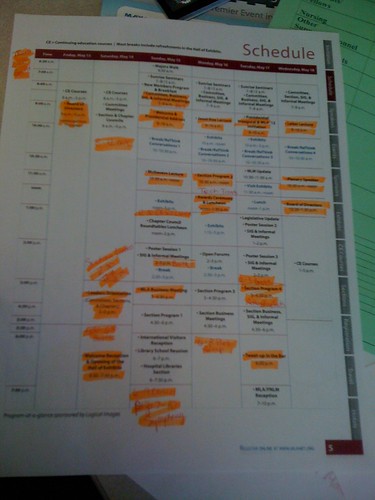
This is a picture of my rough schedule for this meeting…

programplanner by mak1173

I seriously need the online program planner to be live. There are lot of great programs I want to attend (including Top Tech Trends V #mlattt).  I am also a part of the 2012 NPC and a newly elected member of the MLA Board, so my schedule is filling up fast.

So far, this is the best way I have come up with planning schedule at my MLA until the online program planner is available. It seems each year I need to map my meeting out earlier and earlier so that I make sure that my committed obligations don’t overlap.  In the past I used to imput all meetings, programs, events, etc. into Google calendar (synced to my iPhone).  I could easily look at where I needed to be and my phone would buzz 10 min. prior to remind me. 

It is a bit tedious to set up since in the past the online program planner didn’t sync to iPhones or something like Google Calendar.  Yet once everything is in, it is quite helpful to have.  But, I am wondering if there isn’t a better way to do it and if somebody out there has a better idea.  What do you use to schedule your MLA activities?  Are you old school like my photo, highlighting events and penciling things in the squares?  Or do you have a nifty way to sync everything to your smartphone?  Please share.

Happy National Library Week

I thought about posting this as a Friday Fun, but then if I did National Library Week would have been almost over, so I decided to post it today.

If you are looking for the perfect gift for that special librarian in your life, check out The Bargainist Gift Guide for Librarians.  Of course if none of those things hits there is always chocolate.  Chocolate in the library staff area disappears faster than the library’s ACLS Provider Manuals. 

Of course if you are a librarian and you are looking for a little pick me up, try reading CNN’s article, Librarians: Masters of the info universe. It is written by Kerith Page McFadden, a UNC-Chapel Hill Librarian and talks about different librarians that you might not have known about.

So Happy National Library Week!

Writing for the Social Network

A long time ago, in a galazy far, far away I graduated with a degree in English from Saint Louis University. My senior year I took a class on the history of the English language.  This class still stands out in my mind, for two reasons. The first reason was my floppy disk crashed and I lost the electronic version of my thesis for the class.  Thankfully, I printed an unedited version out prior to the disk going belly up.  It was several versions older but it saved me loads of time and stress than recreating the entire thing.  The second reason I remember the class so well was actual course content.  I can remember being completely interested in the evolution of the English language from Old, Middle, Modern English and how exploration, immigration, and population shifts have created completely different English languages. 

Yet just like the evolution of the English language, writing is evolving too.  David Lee King writes in his post, “Librarians were trained to Write the Wrong Way,” that he learned to write academic papers and other “highly useful stuff…like how to graph out a sentence to discover proper sentence structure.”  I learned the same things.  When I am with my friends and family, my diction, accent, word choice, etc. is different than when I am at work or speaking professionally.  Whether it is on paper as Scott describes, a computer, or a cell phone,  the medium by which we communicate dictates our writing style. 

We still must learn to write formal academic type of papers and articles with proper structure and citations.  But we also must learn how to write for other areas, such as the online world.  We used to call it writing for the web.  But now days there are different styles of writing for the web that are considered the gold standard for that medium.  What works on a web site, will not always work on a blog, Facebook, and Twitter. 

David calls it writing like he speaks.  He says conversational, social writing is the type of writing we want on the web, especially on blogs and social media spaces. Yet if you have been trained to write formally as David has, you may find it difficult to adjust your writing style based on the medium.  Even he says, “I work hard at writing like I speak.” 

I create websites (not as much as I used to) and writing for a regular website (not a blog or any socially type of site) has evolved with main pages having one or two word listings or clusters of words and pictures as the norm.  On internal pages where more information is shared sentences are short and to the point within one or two equally short paragaphs.   The wording, sentance structure, and lay out are different than what you would see in a blog.

In a blog, most people are coming to read and possibly share or discuss your thoughts.  Therefore the writing is longer than a traditional website and the style is almost as if you can hear the writer having a conversation with you.  The style is different but it is still professional. The Unofficial Apple Weblog, is a professional site  where writers converse (often passionately) with readers through the blog and comments.  Some of the posts are more straight forward while others use the speaking style

Facebook is the king of conversational writing. There is a word limit on posts.  So conversational writing on Facebook is not as long as a blog post, but it well exceeds the 140 character limit of Twitter.  Again even the most professional of sites adjust their writing styles for Facebook.  The Cleveland Clinic’s Facebook posts are written in a far different style than the pages on their website, press releases, and certainly articles authored by their physicians.  The Cleveland Clinic uses their Facebook page to reach out and engage the community in health and medicine and their Facebook writing style reflects that.

Where Facebook is the king of conversational writing, Twitter is the king of the one liners.  Writing for Twitter is vastly different than anything else (with the possible exception of texting).  Anybody who doesn’t think it is hard to squeeze interesting and valuable information into 140 characters or less, has not tweeted for long. It is hard and takes a lot of practice.  Not only is the character limit a requirement, there are definite social norms by which you converse.  Not adhering to these norms can cause your tweet to go on unnoticed (best case scenario) or get you in a whole lot of trouble. 

Good writing, either formal papers or online posts, takes practice.  Being observant, continually reading and writing,  helps develop and sharpen your skills, especially in the online world.  Writing is a living breathing communication method and it changes with time and technology.  I am sure in 1440 people discussed quality and style as the printing press changed the way things were written.

MLA 2011: Early Registration Deadline, Hilton Rooms, and Following Online

Don’t forget the deadline to take advantage of the Early Registration discount for the annual meeting ends after April 13th.  On April 14th the price goes up considerably, so take advantage of the opportunity and register now. 

If you have already registered and you are planning on attending you better get a room fast.  The Hilton is comepletely out of rooms, leaving the Hyatt as your hotel option

If you are going there a lot of online resources to help connect you with others:

Now if you are bit like me and look this list and think, wow those are a lot of places to find out about MLA. I don’t have time to look at every site.  Never Fear, use a feed reader (that is why I included the feeds for these sites) to group all of these things together.  That way you go to one place to see updates from all of these sites. 

I use Netvibes to gather feeds, take a look at my screenshot.  On the left hand side I created a tab for Annual Meeting Info, underneath are all of the feeds I subscribe to for the meeting.  In the main frame, all of the feeds are displayed for me to read.  Take a look at the icons underneath More than 2 days ago, you will notice they are different.  That shows you where the feed is coming from.  As you can see there are multiple icons meaning that my multiple feeds are all in the main frame available to read.  Easy peasy.

If I want to share my feeds I simply hover my mouse over thet title and a curved arrow, clock, and double arrow are displayed. (On the screenshot look at the Nicollet Mall article, listed third below More than 2 days ago.)  The curved arrow allows you to share that “article” via Facebook, Twitter, email, etc.

So not only are you able to read about what is going on but you can participate and continue the discussion by commenting on events.

Hurry up register, get your hotel room, and set up your feeds.  If you can’t make to Minneapolis this year we will miss you.  I highly recommend you registering for the e-conference (only $100 if you register before May 16th) and follow events via the feeds.

Be a Star Behind the Camera

MLA is looking for people who are interested and willing to help video the conference. If you are interested take a look at Max Anderson’s call for videographers.

(reprinted from Medlib-l)

Are you handy with a handycam? Do you like technology? Do you yearn for a public outlet from which you can espouse the glories of the MLA conference 2011 in Minneapolis?

Why not apply to be an official videographer for MLA ’11? Official conference videographers earn 3 AHIP points and learn some new skills along the way. 

Last year the videographers took 100’s of videos of section programming.

This year, we will focus more on casual conversations in the hallways, out at dinner, by a giant cherry sculpture, or wherever! (If you are not familiar with Minneapolis, there is a sculpture park and one of the sculptures is a cherry on a spoon.)

 Applications will be accepted until 4 pm CT April 22nd, 2011. Official videographers will be announced April 29th, 2011.  Apply here: .

Microsoft and Google in Healthcare

There has been some recent discussion about Google moving out of the healthcare side of things now that co-founder Larry Page is chief executive.  The Wall Street Journal article, At Google, Page Aims to Clear Red Tape, states “some managers believe Mr. Page will eliminate or downgrade projects he doesn’t believe are worthwhile, freeing up employees to work on more important initiatives, these people said. One project expected to get less support is Google Health, which lets people store medical records and other health data on Google’s servers.”

The article states that Page’s Google will focus on graphical online-ad initiatives, YouTube, Android software, and “several emerging lines of business.” Page also wants more projects to operate more like start up companies within Google (ala YouTube and Android). 

Some, like Diana Manos at Healthcare IT News believe that the Google rumor is false.  

Diana states, John Halamka (author of Life as a Healthcare CIO, and last year’s Leiter lecturer) told her that he has not heard of the rumor.  Not only does John use Google Health as a patient, he is also on Google’s advisory council. 

She also questions the source(s) for this rumor.  According to Diana, the WSJ reported on the rumor with anonymous sources referred to as “some managers”  (which I point out they don’t have to disclose their sources). Diana also is leary of  consulting firm analyst, Gregg Kall, perpetuating the rumor, saying “I am always suspicious of consultants  (or journalists) declaring things without evidence, especially with such a high-impact, search engine word as “Google.” (Clicks, anyone?)”.

While Google continues with their “no comment” comment on Google Health (see Mary Jo Foley’s article). Mary Jo Foley at ZDNet says “Microsoft is moving full-steam ahead with its healthcare push.”  Not only is staffing up but “Microsoft’s HealthVault personal-health-record service, as well as the Amalga integration and analysis products are now in the same business unit as Dynamics CRM and Dynamics ERP products.”  That certainly seems to indicate Microsoft is ramping things up. As Foley points out, even though Google hasn’t indicated they are dropping their product, we haven’t seen many recent updates to it, unlike Microsoft.

So it looks like things are starting to shake up a little bit in the personal health record arena.  It will be interesting to see if or how this will impact the health care institutions and any librarians who are involved in EHRs, EMRs, etc.

Diversity at Conferences?

Sarah Milstein is TechWeb’s General Manager, Co-Chair for Web 2.0 Expo and a tech writer.  In a recent post on radar O’Reilly she writes, “Would I attend my own conference? Why conferences need more diversity.”

Sarah specifically mentions technology conferences where the slate is heavily slanted with men.  She points to popular conferences like TechCrunch Disrupt’s NY 2010 show and the Web 2.0 Summit where 10% or less of the speakers were women.  This is no surprise to Sarah, she says “It’s well-documented that women are underrepresented in the tech sector.” 

As a techie librarian who responsible for some of the section programs for this year’s annual meeting and as a co-chair for the 2012 meeting, Sarah has me wondering about MLA and other library conferences.  Are we diverse enough?

The library world has more women than men, and I like to think that we try and think about physical diversity (women, men, cultural, ethnic, etc.).  But are we providing diverse enough speakers regarding their library background (hospital, academic, special medical, government, etc.)?  Do we provide enough diversity in the program or is it too tech heavy, consumer health heavy, or reference heavy? 

Since I am librarian who likes to work with technology, I tend to focus and attend tech programs, but I do have other interests and I realize there are other librarians who are not as interested in technology.

So in your opinion do medical library conferences (MLA, regional, local) have diverse topics and speakers, or are we trotting out the same people with the same topics?  If you think we could be more diverse, then what are you looking for and in what ways can you think we can accomplish this? Let me know.