Congrats LJ Mover & Shaker Cheryl Rowan

I want to congratulate all of LJ’s Movers and Shakers, but as this a blog on medical librarianship, I want to specifically congratulate Cheryl Rowan.

Cheryl is the Public Health Coordinator for National Network of Libraries of Medicine South Central Region and she is being recognized by LJ for providing innovative outreach to the states within the SCR.  Some of her accomplishments are, “From Beyond Our Borders: Providing Health Information to Refugee Populations” (her newest class), “promoting Health Literacy Through Easy-To-Read Materials” (tutorial), and “Health Statistics on the Web: It’s as Easy as..1, 2, 3!” (tutorial)

Click here to read the Mover & Shaker article on Cheryl. 

Don’t forget to start thinking of other medical librarians who would be good candidates for the 2013 LJ Movers & Shakers.

Bearded Pigs at MLA’12

The Bearded Pigs is the World’s First (Only?) Open Access International Librarian Rock Band. They have been playing at MLA for the last 8-10 years (who’s counting when time flies and you are having fun).  This year the band will be playing both on Sunday and Monday.  A double header!

On Sunday May 20th all are invited to join them for a night of dancing and drinking (cash bar) in “Grand C” of the Seattle Sheraton Hotel.  They’ll start up around 8:00 and play until 11:00.  Now, putting on a rock show isn’t free, so for those of you who want to help the Pigs cover their expenses for putting on the show you might want to consider joining the Thicket Society.  It is $40 for a single membership, $75 for a couple AND you will get a cool limited edition Bearded Pigs MLA’12 concert t-shirt and pin (another piece of flare for your badge).  Just go to http://beardedpigs.net/thethicketsociety.html and you can pay by PayPal or snail mail.  Remember, you don’t have to join the Thicket Society to enjoy the fun on Sunday, all are welcome.

On Monday the Pigs will be playing at the Armadillo Ball.  What is the Armadillo Ball? It is  is a scholarship fundraiser for the Southern Central Chapter of the Medical Library Association (SCC/MLA). Because it is a fundraiser, the ball isn’t free, your ticket into the ball is an armadillo pin (usually costs around $10).  Armadillos can be bought at the door or from an SCC/MLA member.  Not only is the armadillo important to get you into the ball, but it is another crucial piece of flare for your meeting ID badge.  People have whole herds of ‘dillos on their badges. 

I hope to see you there!

Spear Phishing?

I think by now everyone has heard of the term phishing as the gathering information online on an individual or group of people.  But today I read of a new type of phishing, spear phishing.  Spear phishing is using information for pinpoint attacks. 

It is apparently pretty successful because recent spear phishing attacks have “ensnared” several top U.S. government officials and RSA (you know the company that makes those SecurID tokens) and defense contractor Lockheed Martin (using information from hacked from RSA).  According to a CNNMoney article, the attackers were able to trick people into opening email attachments that appeared to come from trusted sources or colleagues.

While we don’t know exactly how hackers were able to hack the government officials and RSA, we do know that many believe that social media sites, especially LinkedIn, serve as a hacker’s gold mine.  According to the article, at a DefCon security conference where they staged a hacker game, Google and LinkedIn were the most widely used resources.

All it takes is getting the name of one of your coworkers and a well created email to get you to click on a link. 

Everything is on the Internet, while I don’t want to discourage people from connecting to family, friends, colleagues and coworkers, but you may want to use some discretion when connecting.  Obviously on Facebook you want to lock down your site.  On LinkedIn, maybe you might not want to put down everything about your current job.

Get Paid to Help Create a Next Generation Resource Tool

InContext is partnering with LWW/Ovid to redesign the next generation of electronic information resources for medical professionals.  Based on previous in-depth observational interviews, InContext has proposed some solutions and ideas to better support people who access journal articles online or conduct literature searches.  Because this is a “next generation” project, InContext is especially interested in working with people who own and smartphones and/or tablets  for work or personal use. 

They are testing their ideas for this next genration project by conducting in-person, paper prototype interviews.  The interviews normally would take 90-120 minutes.  Ovid/LWW is offering an honorarium for participation.  They will be doing interviews March 15-20 and March 29-April 4.

If the idea of being on the ground floor to help shape and create a better tool for accessing online journal articles and conducting literature searches is interesting to you AND you like getting paid for your ideas, then go to http://www.surveymonkey.com/s/LWW_Study to see if you qualify to participate.

Hostile Takeover of Your Phone

It used to be that computer viruses pretty much stayed in the realm of computers. Phones weren’t in that worrisome category yet.  Well time to start worrying a bit.  A recent demonstration at the RSA security conference showed how clicking/tapping a bad web link on your smartphone could give the hacker complete control of your phone.

Uh oh.

According to the article, How a Web Link Can Take Control of Your Phone, by Tom Simonite from Technology Review all it takes is a simple web link to take control over somebody’s cell phone. Simonite described how George Kurtz and colleagues from security company, CrowdStrike, were able to view all calls, texts, activate the microphone to listen, steal data, and the location of the cellphone. 

Kurtz and colleagues played out a scenario on stage that involved hacking a real, unmodified Android phone. Kurtz, playing the role of a busy investor at an industry event, received a text message claiming to be from his mobile carrier asking him to download an update to his phone’s software. When he clicked the link in that message, the phone’s browser crashed and the device rebooted. Once restarted, the device appeared unchanged, but a silent, malicious app had been installed that relayed all his phone calls and text messages to the attacker, who could also track his location on a map.

Basically it is kind of like what Reese and Finch do each episode in the TV show, Person of Interest. Now instead of pointing at the device to gain access the hackers send an email or text message.

While the attack happened using a phone using Google Android OS 2.2 version, it can happen to Android OS 2.3 and other devices, iPhone, iPad, BlackBerry, etc.  According Simonite, “WebKit, the browser component that was exploited, is also at the core of the Web browsers found in Apple’s iPhone and iPad devices, BlackBerry phones, and Google’s TV devices.”

Now this type of hack isn’t cheap but it isn’t outrageously cost prohibitive either, and it only took them a few weeks to do.  The article states they spent $1400 on the black market for information on the 14 known unpatched bugs in WebKit which allowed them to gain full “root” access to the phone and use it install a remote access tool.

This type of hack while a virus isn’t at the viral stage yet.  It still is at the level of attacking a specific individual’s phone not whole bunch of phones.  According to a CNET news article, “An attacker would have to know in advance what operating system the device was running and tailor the message, either SMS or e-mail, to that person to trick them into opening it up and acting on it. This could be particularly dangerous for high-profile targets, such as government officials and CEOs who have a lot to lose if their phone calls and data on their devices were compromised.”

While the average person probably isn’t going to be a victim of this, it is a good reminder that our cell phones are mini computers now and can be vulnerable. 


Free Webinar: Demystifying Research Simplfying the Critical Appraisal

A while back ago Ovid hosted a really good webinar on ebooks and on March 7, 12pm EST they will host the webinar, “Demystifying Research: Simplifying Critical Appraisal.”

The webinar is free, you don’t have to be an Ovid user to attend.  If you are busy that day you can still register and you will be notified when the webinar is archived and available to watch. 

Here is a brief description of the webinar:

 Are you often frustrated when you read research studies? Do you sometimes wonder why they are so challenging? Would you be interested in learning how to use the tool of research to help you improve your patient outcomes through evidence-based practice? If you answered yes to any of these questions, join us for the Webinar: Demystifying Research: Simplifying Critical Appraisal

Anne Dabrow Woods, MSN, RN, CRNP, ANP-BC, Chief Nurse of Wolters Kluwer Health / Lippincott Williams & Wilkins Journals and Ovid Technologies, and Maureen “Shawn” Kennedy, MA, RN, Editor-in-Chief of the American Journal of Nursing, will have a discussion with Dr. Ellen Fineout-Overholt, PhD, RN, FNAP, FAAN, to address the steps to critically appraise research evidence and demonstrate how to embrace the process of distilling the pearls that research has to offer.

Dr. Fineout-Overholt is currently Dean & Professor, Groner School of Professional Studies and Chair, Department of Nursing of East Texas Baptist University. Additionally, she is one of the authors of AJN’s, award winning, Evidence-Based Practice, Step by Step series. 

For some reason everything that is supposed to happen in March for me is happening this week.  I am going to try and attend it live but if I miss it, I will definitely catch it when it is archived and available.

Here is the link to register http://event.on24.com/r.htm?e=399336&s=1&k=024FF768A8F5F7EC09DA0C82711231FF

The Devil is in the Details: Social Media’s Right to Your Content

First let me just say I am not a copyright librarian, law librarian, or anybody who specializes in fair use, perpetual use, distribution, etc.  I am a plain ol’ medical librarian who pretty much knows you can’t use other people’s copyrighted stuff without paying for it or asking permission.  Regarding my own content, that I post out there I am kind of naive.

I am not naive in thinking that whatever I post can be seen by anyone. Oh I am well aware of that.  What I am naive about are the various policies regarding user generated content on multiple social media sites.  We all click through their license and usage agreements and few people sit down a read through the legal jargon to figure out the details.  There is the problem, the devil is in the details.

This issue has come up in the past. I remember an article about about Stefanie Gordon’s famous Space Shuttle picture and Janis Krum’s famous Hudson River plane photo.  Both posted their photos on Twitter using Twitpic, and both photos were used and copied commerically without compensation. Part of the problem could be how they posted their photo.  By using Twitpic both Gordon and Krum lost all exclusive rights to their own photo.  Twitpic has the rights to resell any images loaded by original rights holders (people who post their own photos to share on Twitpic).  Just by loading their picture on Twitpic they gave Twitpic the right to resell the image or distribute it. 

Kind of frustrating.  I am by no means a professional photographer and I am never in the right place at the right time to share a picture like the space shuttle bursting through the clouds, but it still kind of irks me that by using Twitpic I lose my excluse rights to the photo.

This is not unique to Twitpic.  Earlier this week Heather Holmes tweeted about Pinterest’s policy about things you would “pin.”  According to PRNewswire article, Unpinned, Pinterest requires people to pin only things they own and Pinterest is granted rights to that material that was pinned. 

Pinterest users can only pin content that they are the sole and exclusive owner of all or that they have all rights, licenses, consents and releases that are necessary to grant to Cold Brew Labs the rights in such Member Content, as contemplated under these Terms.

Those terms would be…  grant Pinterest operator Cold Brew Labs a “worldwide, irrevocable, perpetual, non-exclusive, transferable, royalty-free license, with the right to sublicense, to use, copy, adapt, modify, distribute, license, sell, transfer, publicly display, publicly perform, transmit, stream, broadcast, access, view, and otherwise exploit such Member Content only on, through or by means of the Site, Application or Services.”

As the article states, most of the people on Pinterest are out of compliance with Pinterest’s policy terms.  Not only do people pin things they don’t own but I am pretty sure that they also don’t have the rights to grant Pinterest that content. Judging from what some people are pinning, they don’t seem to realize they no longer retain exclusive rights to the stuff they do own and pin. 

This got me thinking about my photos and all the stuff I have online and the stuff I would like to retain excluse rights to.  So I did a little digging around within various social media platforms and discovered that Pinterest is not alone.  Pretty much if you are involved in social media, there is at least one platform you belong to that by just posting on it you grant the company rights to your content. 

Companies that if you use, you grant them rights to your content:

Facebook:

You own all of the content and information you post on Facebook, and you can control how it is shared through your privacy and application settings. In addition:

For content that is covered by intellectual property rights, like photos and videos (IP content), you specifically give us the following permission, subject to your privacy and application settings: you grant us a non-exclusive, transferable, sub-licensable, royalty-free, worldwide license to use any IP content that you post on or in connection with Facebook (IP License). This IP License ends when you delete your IP content or your account unless your content has been shared with others, and they have not deleted it.

Google+: (Scroll down to number 11)

11.1 You retain copyright and any other rights you already hold in Content which you submit, post or display on or through, the Services. By submitting, posting or displaying the content you give Google a perpetual, irrevocable, worldwide, royalty-free, and non-exclusive license to reproduce, adapt, modify, translate, publish, publicly perform, publicly display and distribute any Content which you submit, post or display on or through, the Services. This license is for the sole purpose of enabling Google to display, distribute and promote the Services and may be revoked for certain Services as defined in the Additional Terms of those Services.

 LinkedIn: (Section 2B)

You own the information you provide LinkedIn under this Agreement, and may request its deletion at any time, unless you have shared information or content with others and they have not deleted it, or it was copied or stored by other users. Additionally, you grant LinkedIn a nonexclusive, irrevocable, worldwide, perpetual, unlimited, assignable, sublicenseable, fully paid up and royalty-free right to us to copy, prepare derivative works of, improve, distribute, publish, remove, retain, add, process, analyze, use and commercialize, in any way now known or in the future discovered, any information you provide, directly or indirectly to LinkedIn, including, but not limited to, any user generated content, ideas, concepts, techniques or data to the services, you submit to LinkedIn, without any further consent, notice and/or compensation to you or to any third parties. Any information you submit to us is at your own risk of loss as noted in Sections 2 and 3 of this Agreement.

Pinterest:

By making available any Member Content through the Site, Application or Services, you hereby grant to Cold Brew Labs a worldwide, irrevocable, perpetual, non-exclusive, transferable, royalty-free license, with the right to sublicense, to use, copy, adapt, modify, distribute, license, sell, transfer, publicly display, publicly perform, transmit, stream, broadcast, access, view, and otherwise exploit such Member Content only on, through or by means of the Site, Application or Services.

Tumblr:

Subscriber shall own all Subscriber Content that Subscriber contributes to the Site, but hereby grants and agrees to grant Tumblr a non-exclusive, worldwide, royalty-free, transferable right and license (with the right to sublicense), to use, copy, cache, publish, display, distribute, modify, create derivative works and store such Subscriber Content and to allow others to do so (“Content License”) in order to provide the Services.


Twitpic:

You retain all ownership rights to Content uploaded to Twitpic. However, by submitting Content to Twitpic, you hereby grant Twitpic a worldwide, non-exclusive, royalty-free, sublicenseable and transferable license to use, reproduce, distribute, prepare derivative works of, display, and perform the Content in connection with the Service and Twitpic’s (and its successors’ and affiliates’) business, including without limitation for promoting and redistributing part or all of the Service (and derivative works thereof) in any media formats and through any media channels.

You also hereby grant each user of the Service a non-exclusive license to access your Content through the Service, and to use, reproduce, distribute, display and perform such Content as permitted through the functionality of the Service and under these Terms of Service.

WordPress.com: Different from WordPress.org

By submitting Content to Automattic for inclusion on your Website, you grant Automattic a world-wide, royalty-free, and non-exclusive license to reproduce, modify, adapt and publish the Content solely for the purpose of displaying, distributing and promoting your blog. If you delete Content, Automattic will use reasonable efforts to remove it from the Website, but you acknowledge that caching or references to the Content may not be made immediately unavailable.

Companies that I am confused about:

Twitter: (Anything public you put out they will distribute to market your persona.)

Our Services are primarily designed to help you share information with the world. Most of the information you provide to us is information you are asking us to make public. This includes not only the messages you Tweet and the metadata provided with Tweets, such as when you Tweeted, but also the lists you create, the people you follow, the Tweets you mark as favorites or Retweet and many other bits of information. Our default is almost always to make the information you provide public but we generally give you settings (http://twitter.com/account/settings) to make the information more private if you want. Your public information is broadly and instantly disseminated. For example, your public Tweets are searchable by many search engines and are immediately delivered via SMS and our APIs (http://dev.twitter.com/pages/api_faq) to a wide range of users and services. You should be careful about all information that will be made public by Twitter, not just your Tweets.

Kind of confused by their terms of service policy about what I post. In one sentence they say I retain my rights but in the other they say by using their service I am granting them the non-exclusive rights to distribute, copy, etc.

You retain your rights to any Content you submit, post or display on or through the Services. By submitting, posting or displaying Content on or through the Services, you grant us a worldwide, non-exclusive, royalty-free license (with the right to sublicense) to use, copy, reproduce, process, adapt, modify, publish, transmit, display and distribute such Content in any and all media or distribution methods (now known or later developed).

 LiveJournal:

I am not sure. I don’t see anything in their terms of service or their privacy policies about content that users post.

Companies that do not get non-exclusive rights to your content simply by using their product:

Flickr:

Flickr’s policy appears to preserve your rights to your content.  It all depends on how you license your content on their site.  Also interesting, Flickr recently went after Pinterest blocking users from pinning copyrighted material on Flickr. Based on their policy and the recent blocking of Pinterest, it appears that Flickr does not get non-exclusive, irrevocable, yada yada use and distribution of your content. 

 WordPress.org: Different from WordPress.com

With WordPress.org you are using their software to publish your material on your own domain.  They have no wording in their policies stating that the use of their software grants them rights to your content. They do however have  your information and they collect non-identifying information for statistics and software development. Personal data they have will only be released under specific circumstances.

 However, you might want to check with your domain host to see if by using them they get non-exclusive rights to your content.

*Note* If you use WordPress.org or another blog and you post it through Facebook then you are granting Facebook permission to have non-exclusive, transferable, sub-licensable, royalty-free, worldwide license to use your blog content. Perhaps if you want your blog content featured on Facebook but you want to retain your rights you might just give the link and brief 2 sentence description on your Facebook post.

MySpace: Not many people use it any more but those who do don’t have to worry about MySpace using their content

Myspace does not claim any ownership rights in the text, files, images, photos, video, sounds, musical works, works of authorship, applications, or any other materials (collectively, “Content”) that you transmit, submit, display or publish (“post”) on, through or in connection with the Myspace Services. After posting your Content on, through or in connection with the Myspace Services, you continue to retain any such rights that you may have in your Content, subject to the limited license herein. By posting any Content on, through or in connection with the Myspace Services, you hereby grant to Myspace a limited license to use, modify, delete from, add to, publicly perform, publicly display, reproduce, and distribute such Content solely on, through or in connection with the Myspace Services, including, without limitation, through the Myspace Services to applications, widgets, websites or mobile, desktop or other services which are linked with your Myspace account (collectively, “Linked Services”), including, without limitation, distributing part or all of the Myspace Services and any Content included therein, in any media formats and through any media channels, except that Content marked “private” will not be distributed by Myspace outside the Myspace Services and Linked Services.

 yfrog: (Service for tweeting out pictures)

The content that you distribute through the ImageShack Network is owned by you, and you give ImageShack permission to display and distribute said content exclusively on the ImageShack Network.

You may revoke this permission at any time by requesting your content to be removed. Such requests will be processed within a maximum period of 24 hours (but usually as short as one hour). You may request deletion and/or mark your content private through our sites’ user interfaces, or by contacting ImageShack directly. After your request is processed, ImageShack will cease distribution of your content within a maximum period of 24 hours (but usually as short as one hour) and will absolve itself of any ownership of said content, implied or otherwise.

ImageShack will not sell or distribute your content to third parties or affiliates without your permission. Third parties may exercise the following options regarding your content:

  • Third parties may hyperlink to the page that displays your content on the ImageShack Network without modification and with proper attribution to you.
  • Third parties may request permission to use your content by contacting you directly.

All requests for permission regarding your content usage directed at ImageShack will be forwarded to you. All uploaded content is copyrighted to its respective owners. ImageShack directs full legal responsibility of said content to their respective owners. All content generated by ImageShack is copyrighted by ImageShack. ImageShack is not responsible for any uploaded content, nor is it in affiliation with any entities that may be represented in the uploaded content.


This list isn’t comprehensive, isn’t intended to be legal advice and if I have something wrong please let me know.  If you use another social medial site and want to feature it in the list, please leave a comment and I will integrate it into the list.

I didn’t list every single social media company out there so if you use one and are concerned take a look at their policies.  As I said in the beginning. the devil is in the details. It is almost impossible to participate in social media without some exposure and granting some companies rights non-exclusive, transferable, sub-licensable, royalty-free, worldwide license to use your content.  The key is knowing what you can live with.  As I mentioned, I don’t post my entire blog on Facebook.  I do have a few pictures (family, renovations, vacations, etc.) on Facebook, but that isn’t my entire photobook. My entire photo collection lives on Flickr and I upload specific pictures from Flickr to Facebook.  Additionally, I am trying to get in the practice of using yfrog for tweeting out pictures. 

The idea with social media (and everything else) is read the instruction manual (policies) and use with caution and thought.

MLA Welcome Reception

I posted on the Official MLA’12 Blog about the MLA Welcome Reception and how we are turning it into Opening Day at the ballpark.  It will be a fun environment with opportunities for people to mingle and enjoy the beginning of the conference.

Since it will be Opening Day, we are encouraging everyone to wear their favorite team jersey.  It doesn’t have to be an MLB jersey either. It can be a Triple-A team, your kid’s team, any team.  Heck, if you aren’t a baseball fan go ahead and where the jersey of another sport.  There is nothing wrong with a little mixing and matching of the sports. After all, football commentator, John Madden, brings his own bunting to hang from his booth during football games because he likes the way it looks at baseball games. 

If you aren’t into sports but you are into supporting MLA scholarships check out the MLA Scholarship Booth and buy the Official MLA ’12 t-shirt/jersey.  (Seen on me below.)

mla12shirtfront

The idea is to have a good time and the jerseys and the theme make for an easy ice breaker to help people meet others they may never have met before or see only in name on the listserv.  One of the top reasons people give for attending MLA is to network and we at the NPC hope our theme and our Opening Day reception help foster that ability.

I mentioned on the Official MLA’12 Blog, I will be wearing my favorite baseball team (1982 St. Louis Cardinals) and player’s jersey (Ozzie Smith) during the Opening Day reception.  I will also be wearing my MLA jersey around the meeting and I am toying with the idea of totally getting into the theme and wearing different jerseys from other favorite teams through out the meeting. 

I have said it before, if you see me please come up and say hi.  Not only do I like meeting people but as a MLA Board member I value the thoughts, feedback, opinions, etc. from  and contrary to what I have told my children, I can’t read minds. 

We have a great program and we hope to see you there!

How Do I Generate Interest in QR Codes?

This project was to increase awareness our patron’s awareness of our e-book collection and I am worried I am going to going to become Sisyphus in the process.

Problem:
E-books are hard for patrons to know about.  We still have a large group of users who peruse the stacks for books on a topic. 

Possible Solution:
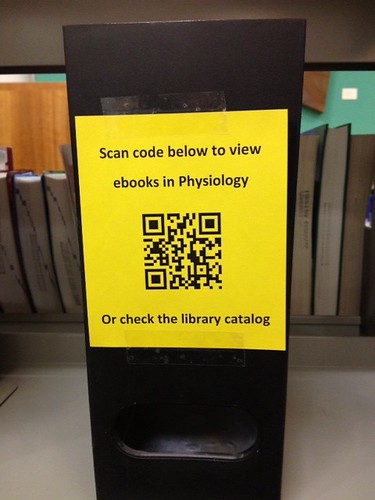
Put the subject list of e-books within eyesight of those who browse the shelves.  Create a brightly colored message to be displayed on the shelves informing people of our ebooks and how to access them.

Ideal outcome:
Users will see the QR code and scan them with their smartphone to view a list of ebooks within that subject.  We are using http://www.delivr.com to create the codes and track their usage. Users without smartphones will see the note and check the catalog for ebooks. 

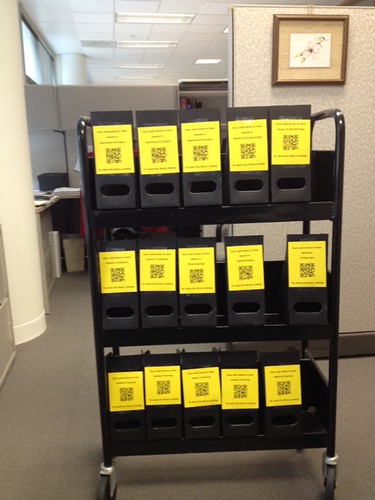
Used bright yellow paper and old unbound journal holders.

QR1


Made multiple notices for each subject area depending on the size of print collection (area it spans on the shelves).

ebookscart


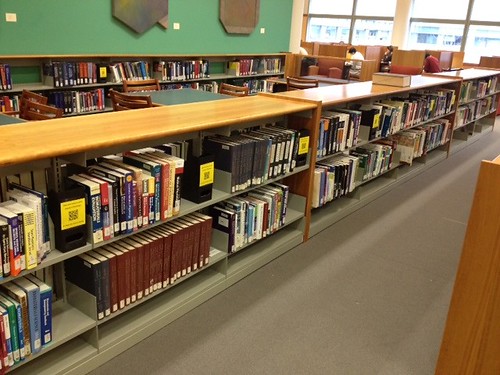
Distributed the notices through out the stacks within each subject area and spaced for maximum viewing opportunity.

QRs In Stacks
 

We haven’t invested anything into this project other bright yellow paper and my time.  We used the many unbound journal holders that we had left over from our print journal days to post the yellow paper and as place holder in the stacks.  Even the QR code generator and tracker is free.  The only thing that really wasn’t free was our e-books but we bought them long ago before QR codes were known to geeks. 

So while we haven’t invested anything in the project. We have a vested interest that our e-books get more usage.  This project is just another way to drive attention to them. 

Still, I am plagued by a persistent little voice in my head asking whether people will even bother to scan these codes.  Because according to the CNN Tech article, Why QR Codes Aren’t Catching On, “many people don’t understand what QR codes are or what to do with them.”  The article cites a study by Archival which found that while “80% of students owned a smartphone and had previously seen a QR code, only about 20% were able to successfully scan the example QR code they were shown. Furthermore, about 75% said they were unlikely to scan a QR code in the future.”  Even if people know what a QR code is and know how to scan it this Market Plan post says, Consumers Still Don’t Know What to do With QR Codes

I really want this project to work, but these articles suggest I have an uphill battle.  It is going to take a lot of promoting and educating to get this QR code thing moving. 

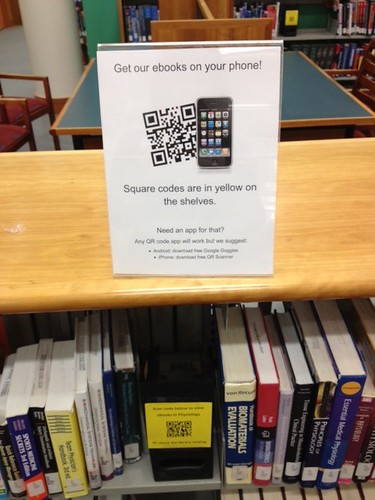
I have begun to post signs through out the library and strategically next to QR codes in the stacks (see the yellow code below the sign) promoting our e-books and the QR codes.

QRsign


I finally got all of the yellow QR code signs in the stacks and the advertising signs up on Friday.  It is Monday and while I know I have a long way to go before I know if this project is boom or bust, I need to come up with some more educational and promotional ideas to get it off to the best possible start.  So I am asking you all in the library world to throw me some suggestions via your comments.  The suggestions won’t only help me, they will help others who are thinking of doing the same thing.

Friday Fun: What Happens When All We Have Are E-Books

Cracked.com has a fun post, “8 Unexpected Downsides of the Switch to E-Books.” Instead of looking at the “boring” issues that happen as ebook sales overtake regular book sales, Christina H decided to “find some e-book ramifications that would appeal to the type of people who spend more time preparing for a zombie apocalypse than like, unemployment, or retirement, or something. You know, realists.”

In the interest of Friday Fun, I thought I would expand on her list of what we will miss out on when all of our books go electronic.

9. You can’t secretly read a comic book inside the cover of your history book. 

Kind of a messy way to pretend to be reading something else.  The old way was much better.

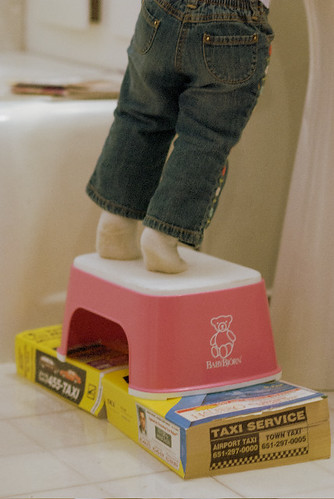
10. Kindles and other e-readers just aren’t thick enough or easily stacked to be effective when you have to keep a chair or table from tipping.

Oh yeah you can try a matchbook or folded paper, but for the truly shortened leg you need a book.  Or if you are an engineer like my dad and need to put stripe wall paper up in a stairway with a vaulted ceiling, you can use a combination of books, old bricks, a son-in-law, and a rickety old ladder precariously placed on the steps to help you reach the ceiling to wall joint. (Unfortunately, I have no pictures of that engineering marvel but witnesses can attest to the use of books.)


(Oh look an little engineer in training, my dad would be so proud.)

11. You absolutely cannot use a Kindle as an ad hoc booster seat, you need a good thick book for that.  Back before booster seats were en vogue, my mother, the nurse, made us each sit on a telephone book when we sat in the back seat of the car so that the seat belt went across our hip bones instead of our tummies.  My mom was a visionary, in 1970 she created the booster seat.  Of course now we have real safety booster seats, but the big thick book is still needed to give a boost to ones bottom.

booster

Do you have any other suggestions on just what we will be losing when the world goes all e-book?  Let me know?