NLM Show Off Your Apps Contest Winners Announced

The winners of the National Library of Medicine’s Show Off Your Apps contest were announced

The five winners are:

GLAD4U – (Gene List Automatically Derived For You) is gene retrieval tool that uses NCBI’s program utilities and gene ID mapping tables to find information associated with each gene, publications, and links for “file exports and further functional enrichment analyses.”

iAnatomy – An interactive anatomy atlas that can work without an Internet connection and allows people to search and zoom in on structures.

KNALIJ – Offers researchers a method to deal with massive amounts of data by making connections linking biomedical and life science research and researchers around the world.  These link can also be visualized to allow for easier exploration analysis and education.

NLMplus – Provides a emantic search a discover application to the large amount of information and services in NLM.

Quertle – Instead of using keyword searching it uses linguistic methods to find the most relevant documents.  Quertle is for life science professionals searching multiple life science literature resources including Medline.

For list of the honorable mentions go to http://apps.nlm.nih.gov/175/show_off_your_apps_winners_honorable_mentions.cfm


Last Chance to Try and Win $400 Towards MLA 2012

Tick Tock, Tick Tock….. You hear that?  That is time running out for you to try and win $400 toward the annual meeting in Seattle.

The National Program Committee for the 2012 meeting in Seattle, WA are looking for the best methods people used to justify their attendance at a meeting to receive funding from their institution. There will be two $400 prizes to be used toward either registration or travel expenses to the 2012 meeting. The two prizes will be awarded to one hospital librarian and one academic medical librarian for the most original, funny, interesting, and best method for acquiring funding from their institution.

You must submit your story online by 11:59pm November 1, 2011. Winners will be notified by November 25, 2011 and there stories will be listed in the January 2012 MLA News. All submissions will be displayed online and available at http://mla2012contest.wikispaces.com/ for your fellow librarians to read and learn from. By participating in this contest, not only do you have the chance to win money to help pay for next year’s meeting, but you are sharing your successful funding strategies which can serve as a resource to other librarians who may need a little help getting institutional support.

To enter the contest go to: http://www.surveymonkey.com/s/2T8K9LJ
You must be an MLA member to win.
Nervous about seeing your name in lights about how you got your institution to support your attendance? That is fine. We have set it up so that you can participate in the contest but your name will be withheld from the online public site and will only be known to contest judges.

What are you waiting for? Get online and submit your story! 

The wiki listing the stories is current as of 10/28/11 6:30pm est, so look through them and submit your story at http://www.surveymonkey.com/s/2T8K9LJ.  If you are looking for ideas on how to get money to attend MLA ’12 read the stories, maybe one of them will work for you!

Friday Fun: Cheer for the Cardinals

The World Series is going on right now and my home town team the St. Louis Cardinals are playing the Texas Rangers.  Normally, I would root for the team that hadn’t won a Series yet, but unfortunately they are playing the team I grew up with.  I cannot root against the Cardinals, it is physically impossible.  I may be living in Cleveland, but I am a St. Louisian. 

My brother, the investment professional, just sent me another good reason to root for the Cardinals to win the World Series.  A reason that all of us with our limping along 401ks can appreciate.   Apparently the Dow Jones industrial average has risen an average of 12.9 percent in the calendar year after the Redbirds with the World Series. That is the best of any team with at least 4 World Series wins.  So even if you aren’t from St. Louis, you still might want to cheer the Cards on to win. 

So if you don’t live in St. Louis or Dallas and you haven’t picked a team to cheer for, you might just want to think about rooting for the Cards.  However, if you are a Dallas fan (or a Cubs fan incapable of cheering for the Cards) all is not lost.  According to the stltoday.com article the market has risen an average of 8.97 percent the following year after a first time winning team has won the Series. 

Still…I am cheering for the Cards.

Time is Running Out To Get FREE Money!

I thought briefly about changing the title of this blog post because it sounds like one of those spam messages you get, but it isn’t spam.  It is real!  If you are a member of MLA you have a chance to win $400 toward the Annual Meeting in Seattle and TIME IS RUNNING OUT!

The National Program Committee for the 2012 meeting in Seattle, WA are looking for the best methods people used to justify their attendance at a meeting to receive funding from their institution. There will be two $400 prizes to be used toward either registration or travel expenses to the 2012 meeting. The two prizes will be awarded to one hospital librarian and one academic medical librarian for the most original, funny, interesting, and best method for acquiring funding from their institution.

You must submit your story online by 11:59pm November 1, 2011. Winners will be notified by November 25, 2011 and there stories will be listed in the January 2012 MLA News. All submissions will be displayed online and available at http://mla2012contest.wikispaces.com/ for your fellow librarians to read and learn from. By participating in this contest, not only do you have the chance to win money to help pay for next year’s meeting, but you are sharing your successful funding strategies which can serve as a resource to other librarians who may need a little help getting institutional support.

To enter the contest go to: http://www.surveymonkey.com/s/2T8K9LJ
You must be an MLA member to win.
Nervous about seeing your name in lights about how you got your institution to support your attendance? That is fine. We have set it up so that you can participate in the contest but your name will be withheld from the online public site and will only be known to contest judges.

So hurry up time is running out.  The wiki listing the stories is current as of 10/20/11 10:30 est, so look through them and submit your story at http://www.surveymonkey.com/s/2T8K9LJ.  If you are looking for ideas on how to get money to attend MLA ’12 read the stories, maybe one of them will work for you! 

It is $400 people!  Get typing!

Time to Give Up the Brandon Hill List and Move to Doody’s Core Titles?

A long time ago in galaxy (not so) far, far away, there was a list that would identify essential texts for medical libraries.  This list was called the Brandon-Hill list and it was a very fine list used by many medical librarians through out the land.  But in 2003 there was a disturbance in the force, the list would not go on, it ceased to exist.  However, Doody’s Core Titles emerged, filling the void of Brandon-Hill. 

James Shedlock wrote an interesting article, “Coping without Brando-Hill is Easy; Replace it with Doody’s Core Titles” describing briefly the history and creation of Doody’s Core Titles (DCT) and the reasons why librarians really should stop looking at the old and super out of date Brandon-Hill list and begin to use products like DCT to assist them with their purchasing. 

Now I realize this article is in Doody’s and is written by somebody on the board and is blogged about by a board member (me) as well. So to give you some other perspectives about Doody’s I am also including links to several reviews on DCT so librarians can make an informed decision.  Because, clinging to the old Brandon-Hill list is not an option. As James mentioned, “Though the old Brandon-Hill list was free, it was dated and now no longer exists; it is gone and is not coming back.”  It is time to move on.

Doody’s Core Titles in the Health Sciences (DCT)
Karen S. Fischer
J Med Libr Assoc. 2005 July; 93(3): 409.

 
Review of Doody’s Core Titles in the Health Sciences 2004 (DCT 2004)
Mark A Spasser
Biomedical Digital Libraries 2005, 2:5 (29 June 2005)
 
Anybody know of any newer reviews please leave the citation in the comments and I will add them to the post.
 

The Complexities and Economics of Open Access

Our budgets are shrinking. Libraries are cutting things they once never dreamed of cutting.  The sacred library cows are being sacrificed.  As this is happening there is much vitriol directed at the for profit publishers, the Elseviers, LWWs, and Springers of the publishing world.  After all, they are making a huge profit at the expense of the libraries.  All they care about is money not about the common good of providing access to medical knowledge.

Therefore it was interesting to read T. Scott Plutchak’s post “The Economics of Open Access,” where he states open access publishers are achieving just as high of profit margin as some of the for profits. “PLoS achieved a 20% margin in 2010, and if the trends continue, could conceivably surpass Elsevier’s margin for 2011.  Springer claims “double-digit” profits from BioMed Central.”  So it is OK for PLoS to have that profit margin, but not Elsevier?  Librarians don’t fool yourself, that money comes from somewhere.  Is it really better that the author has to pay $1000-$2000 to publish the article instead of the library paying for the journal?  Well it isn’t in our budget so who cares if it is out somebody else’s budget, right?  But as Scott says, “If publishers add no value, as the anonymous Deutsche Bank analyst proclaims, isn’t PLoS just as immoral as Elsevier?  Shouldn’t we be just as outraged?”

Scott lists several points questioning various issues on the OA debate.

  • If you believe that publishers add no value, then you can’t support PLoS any more than you support Elsevier.
  • If you believe that commercial publishers are the bane, then you should be as opposed to BioMed Central as you are to Elsevier.
  • If you believe that “excess profits” (somewhat of an odd concept, since profits are excessive only when they’re not your own) are the problem, then you need to recognize that OA is not the solution and be as wary of the successful gold & hybrid publishers as you are of the others.
  • If you believe that the most important thing is more and more access, then you should applaud the experiments of the commercial publishers every bit as much as you applaud the others.

We librarians scream and yell about the inequities of the for profit publishers but as Scott points OA is not the panacea that many think it is.  I guess it is OK to make a huge profit if you aren’t a “for profit” company.  I have a news flash, non-profits aren’t exactly trying to break even, they are trying to make as big of a profit as “for profit” companies.  Non-profit is just a tax designation, non-profits still make profits (some more than others). As Forbes says “When we hear ‘nonprofit,’ most of us imagine an organization filled with the ultimate do-gooders: those angelic advocates who are willing to sacrifice their own financial gain to serve a noble cause.”  Yet many of wealthiest non-profit companies make more than many for profit companies and the CEO’s, professors, and winning coaches of these non-profits are called the non-profit millionaires.  Take a look at the compensation of the wealthiest non-profits from Forbes.

I am not saying that the pricing for journals and other library resources aren’t out of whack with that of our budgets, they are.  But to put it into a good (non-profit) vs. evil (for profit) scenario doesn’t solve the problem.  If we believe David Crotty’s post in the Scholarly Kitchen (where Scott got his PLoS 20% profit information), the “good guys” are making just as much profit as the “bad guys.”  They both are for profit.

The iPad: Success=Perception

Beauty is in the eye of the beholder, it is all about perception. The same can be true of IT and whether certain initiatives are successful.  Jeff Coghill emailed me a link to the article,” IT leadership often determines iPad success in the enterprise” which explains that it is how IT approaches the iPad as to whether it is successful. 

If IT reluctantly buys some iPads because “everyone is doing it” and they are looking for a problem for the devices to solve, the iPad (and really anything bought with this approach) is doomed for failure.  “iPad succeeds or fails in your enterprise is often driven by the IT leadership’s perception of the device. If you open the box and see headaches ranging from manageability to access control, save yourself the agony and leave the iPad to consumers.”

If IT approaches it from the perspective with the need first and the tool second, then the iPad (or any tablet device) has a chance to be sucessfully implemented.  With this approach the article states, the iPad may be  “be the technology ‘duct tape’ you’ve been waiting for — that is, a cheap (but imperfect) solution to all manner of enterprise problems.” 

If you own a home you know that there is never a shortage projects, no matter how updated it is.   Buying an iPad or tablet and trying to make it solve problems is like buying a flat head screwdriver at Home Depot before you looking at the screws to determine you really need a phillips head.  You can sort of maybe get the phillips head screw out with a common screw driver but you won’t be happy with the results.  Knowing your needs ahead of time and looking at what issues must be solved allows you to choose the right tool for the job.  Same goes with IT.  

So it really is the attitude of the IT department as to whether any device is adopted successfully. While many hospital IT departments are not well known for embracing technology with an open mind, some are definitely more open than others.  John Halamka, Chief Information Officer of Beth Israel Deaconess Medical Center and Chief Information Officer at Harvard Medical School, writes often about finding new things to solve current problems.  Often he writes about new IT things like  using Apache Hadoop to “leverage commodity hardware infrastructure, reduce risk, and meet user demands for mining big data” might be something to investigate.  Sometimes though, he writes about finding cool new things that solve his personal problems like finding good lightweight shoes for light hiking and kayaking.  Reading his blog, you get the idea that he knows his needs ahead of time and isn’t fussy with where he finds the right solution as long as it is the right solution. 

It takes an open mind to look outside of the box to address the needs, this is where innovative hospitals with innovative IT departments and CIOs shine while other good hospitals just stay good hospitals.

MLA 2012/2013 Election Candidates Announced

The candidates for the upcoming 2012/2013 MLA election have been announced.  MLA members will be able to cast their vote online from November 2–December 6, 2011. Members without email addresses on file at MLA headquarters will receive paper ballots in the mail during the first week in November. Election results will be announced in December.

Not a member of MLA because the organization isn’t relevant to you and what you are facing in the profession?  Well if you aren’t a member, you can’t vote for MLA to change to become more relevant to you and others in the future.  Become a member so that you have a voice in the organization to see that it changes and evolves in the future to be relevant to you and other librarians.

Congratulations candidates and good luck!

MLA President Elect

  • Dixie A. Jones, AHIP, Medical Library, Louisiana State University Health Sciences Center–Shreveport
  • Cynthia L. Henderson, AHIP, Louis Stokes Health Sciences Library, Howard University, Washington, DC

MLA Board of Directors (two open positions)

  • Debra Rand, AHIP, Health Sciences Libraries, Hofstra University North Shore-Long Island Jewish School of Medicine, Hempstead, NY
  • Chris Shaffer, AHIP, OHSU Library, Oregon Health & Science University–Portland
  • Brian P. Bunnett, AHIP, Health Sciences Library and Informatics Center, University of New Mexico–Albuquerque
  • Julia M. Esparza, AHIP, Medical Library, Louisiana State University Health Sciences Center–Shreveport

MLA Nominating Committee (nine open positions)

  • Neville D. Prendergast
  • Priscilla L. Stephenson
  • Max Anderson
  • Jane Bridges, AHIP
  • Sherrilynne S. Fuller, FMLA
  • Mindy Robinson-Paquette
  • Keith W. Cogdill, AHIP
  • Patricia E. Gallagher, AHIP
  • Paula G. Raimondo, AHIP
  • Melissa L. Just, AHIP
  • Lynne M. Fox, AHIP
  • Ana D. Cleveland, AHIP
  • Brenda Faye Green
  • Diana J. Cunningham, AHIP
  • Jo Dorsch, AHIP
  • Joy C. Kennedy
  • Lisa K. Traditi, AHIP
  • Heidi Heilemann, AHIP

Apple’s Medical Apps Section #Fail?

According to iMedicalApps, “Apple tries to help doctors categorize medical apps, but falls short.”  I mentioned last month that Apple created a medical/health section to help healthcare professionals get to good apps and not have to sift through the junk in the general health and medical section in iTunes. 

At that time I was concerned about who would be adding and vetting the apps.  It seems this concern was justified.  Although it appears the section isn’t just an open free for all for any app developer, there is some frustration with what is and isn’t listed in the categories.   

In his post, Iltifat Husain, expresses his concerns not only about the type of apps in the new section but the type sub-categories as well.  “The imedicalapps team was expecting apps to be separated by specialities — or at least by broad medical professionals, such as “nursing”, “EMS”, and “physician centered” — but this was not the case.  Apart from the issue with sub-categories, Apple missed the mark with not only the apps that were included, but also the extremely useful apps they excluded.”

Iltifat does a really great job evaluating the new medical apps section and he goes into a lot of depth regarding the sub-categories in the section and what apps are listed there and what are not. 

I only disagree slightly with his complaints, specifically about sub-categories.  Iltifat would rather see apps in organized into profession sub-categories rather than function sub-categories.  Apple chose to have 6 sub-categories; Reference, Education, EMR & Patient Monitoring, Imaging, Point of Care and Personal Care.  I understand Iltifat’s argument that nurses would rather just go to the nursing sub-category to download all of their needed apps rather than bounce around to different categories to download apps here and there.  However, given that an app on EMR and Patient Monitoring could be in multiple profession categories (doctor, nurse, etc.) I can see why the creators chose to go with function of the app as a category rather than who it is directed towards.  Tomato…tomahto.  Welcome to the world of librarians where we try to categorize everything to make it easy for everybody to find.  As hard as we work at, and as much as we think we did a good job of categorizing, somebody doesn’t think that method of organizing makes sense.

Apple’s method of organziation makes even more sense to me as I read Iltifat’s very good argument that many of the apps listed in the categories are either not really professional apps (WebMD in Reference), are too old to be listed as a good app (USMLERx Step 1 in Education), or missing crucial apps (Osirix and ResolutionMD in Imaging).  The people who organized these apps were not medical professionals and weren’t medical librarians familiar with the medical app world.  The fact that they made several errors not only in the inclusion and exclusion of apps but also what is considered professional and consumer tells me that they wouldn’t know what apps would be appropriate for nurses, doctors, EMS, etc.  Basically they did the best they could. 

There are pros and cons to having the apps organzied by either profession or function sub-categories.  As a result the medical librarian in me would say have both sub-categories with the apps listed in multiple places.  However, that would require them to have a professional (dare I say it?) indexing the apps, placing them in the correct categories and also selecting (and deselecting) appropriate apps as they are developed.  The Apps for Healthcare Professionals section needs a medical librarian, but clearly they don’t have one.

It would seem that the Apps for Healthcare Professionals is a basic place to start if you are medical professional  and you have time to sift through the general medical/health category to find those quality apps that for some reason didn’t get into the professional apps section.  Medical professionals are probably still best served by either looking at what their library suggests/offers or using the web to find suggestions from other medical libraries or sites like iMedicalApps.   

There are many medical librarians out there already selecting apps for that would be of interest to their users or are available through institutional subscriptions.  An added bonus is that many of the medical libraries list more than just iPhone apps (which iTunes of course does not) so it is a one stop shop for many professionals with different devices. 

Some of the libraries that already have lists are:
(Please note if app requires institutional subscription)

So if you are like Iltifat and frustrated Apple’s attempt at organizing medical apps, a medical librarian looking for a good list of apps to start your own list, or somebody that doesn’t have the almighty iPhone, you might want to look at a medical library.
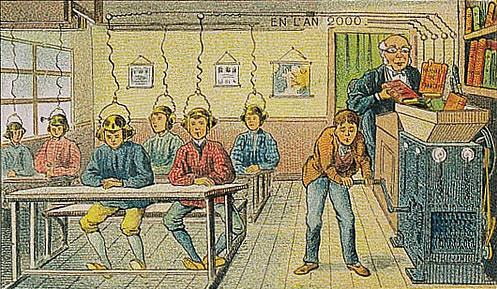
Friday Fun: Audio Books of the Future

The Centered Librarian recently posted these drawings and I thought they would be perfect for a little Friday Fun.  These are illustrations by French artist Villemard in 1910 of what he imagined the future to be like in the year 2000.  For other prognosticating fun this Friday, you might want to check out Tex Avery’s Car of Tomorrow (YouTube) and his House of Tomorrow (YouTube).