Docline Update

To those of you who aren’t on the Docline discussion list or may have missed the post on Medlib-l, if you are using Microsoft Internet Explorer 6 you need to upgrade ASAP. 

Docline does not support Internet Explorer 6. (They stopped August 31, 2009.) They can no longer offer customer support of issues reported with that browser.  If you are still using Explorer 6 you are strongly encouraged to upgrade to Internet Explorer 7 or 8 or Firefox 3.5. 

If you have been limping by on Internet Explorer 6 and everything has been good so far, you might be interested to know that next release of Docline is coming shortly.  So if you are running IE6 right now, you won’t get any support from NLM if things go wonky with the next release.

Medlib Blog Carnival

It is Monday March 8, 2010 and is time for the monthly Medlib Blog Carnival hosted at the Krafty Librarian.  Next month will be hosted at EagleDawg so if you missed this month’s deadline please consider submitting your post to next month’s carnival.

So without further ado, let’s get this party started.

Laika’s MedLibLog starts us off with the book review Searching Skills Toolkit. Finding the Evidence [Book Review].

“Most books on Evidence Based Medicine give little attention to the first two steps of EBM: asking focused answerable questions and searching the evidence. Being able to appraise an article, but not being able to find the best evidence may be challenging and frustrating to the busy clinicians.”

Vivo project blogger and Bioinformatic Specialist at Becker Medical Library Kristi Holmes blogs about Libraries: perfect partners for research.

“There’s no doubt about it – we’re in the age of interdisciplinary science and it seems like everyone is looking to build innovative research teams. Unfortunately, it can be difficult to discover collaborators and make meaningful connections within one’s own building – let alone across campus or beyond.”

Medical and health librarians who like to pair some of their outreach and marketing efforts around various health observance days, months, etc. might be interested to read the post  The National Health Observances Toolkit by Walter Jessen.

In Dr. Shock’s post Read It Later, he discusses using the product Read It Later as a better alternative to Evernote and Google Notebook (of which Google dropped the development).

Nikki Detmar author of the EagleDawg blog (and next month’s Carnival Hosts) sets the bar for next month by submitting two of her interesting posts and recommending another post from Dean Giustini.

Nikki’s two posts Joint Commission: Transparency Obscured? and Ben Goldacre explains the placebo effect are great and Dean’s Top (20) Semantic Search Tools 2010 for those interested in a semantic search engines is a must read.

In the post, More Women Get Heart Disease Information from *the Newspaper* Than the Internet? Rachel Walden finds it odd that in this day and age when Pew Internet says more people are looking at the Internet to answer their health questions that still more women get their information about heart disease from newspapers.

Finally, Alisha Miles provides her insights on Rounding: A solo medical librarian’s perspective and also thoughts on the possibilities of ‘Beam’ing medical videos.

I hope there was something here that interested you and helped you think of things a little differently.  Additionally if you planned on submitting this month but it slipped your mind you still have the opportunity to submit a post for next month to be hosted at EagleDawg  just submitting your post.

Dirty Hands? There’s an App For That

Microbe Magazine has an interesting article and an audio interview about two ways people are using mobile devices and social networking to help monitor hand washing compliance and track infectious diseases.   

The first method they describe is an iPhone app called iScrub (free and available on iTunes App Store) which was developed to “automate the monitoring of hand-hygiene practices in health care settings.”  Originally developed for hospital settings, the article states the app could be as a “stealth app” to be used in other non-hospital environments where hand hygiene is important such as food handling. 

The second method they describe is using Twitter to track infectious diseases.  The article states Alessio Signoroni and Philip Polgreen used the 2009 H1N1 outbreak to test Twitter as method for tracking disease outbreaks.  They started in April 2009 and by June they had collected 950,000 tweets containing terms such as H1N1, swine, flu, or influenza. 

And you thought iPhone apps and Twitter were just for fun and had no real world value?  While I know there are practical applications for these tools, I have to admit I would have never thought about creating a hand washing app or tracking tweets.  It will be interesting to see how these and other things like them pan out.

MLA and CrowdVine

In an effort to connect to more members MLA is experimenting with meeting based social network site called CrowdVine.  Connie Schardt wrote a nice little piece about it on Medlib-l. MLA has created a customized CrowdVine site for the 2010 meeting to help participants interact “before, during and and after the meeting.” 

The CrowdVine site links has links to the official meeting page, official blog, and allows members to set up RSS feeds into the site (blog posts, photo streams, social bookmarking, etc.)  As Connie mentions, “the real power of the service is its ability to identify participants that share common interests that they can seek out and meet, in person, at the conference.”

Hop on CrowdVine look around and if you are interested sign up and start adding some of your information or join in a discussion.  If you are more of the lurking type, sign up and just watch what happens, who knows maybe you might go from lurker to occasional contributer.

Call for Bloggers for MLA 2010

Molly Knapp will be at the helm of this year’s conference blog and she has put out the official call for medical librarian bloggers

(reprinted from the MLA’10 blog)

Do you like to write? Do you like technology? Do you yearn for a public outlet from which you can espouse the glories of the MLA conference 2010 in Washington DC?

Then why not apply to be an official blogger for MLA ‘10? Official conference bloggers earn 3 AHIP points and may have access to free wireless services for the duration of the conference.

More information

Application

The application will be open until April 20th, 2010. Official bloggers will be announced April 30th, 2010.

Because how else are you going to share your Obama photo with the world’s premier league of  health sciences information professionals?

Last year we had a wonderful group of bloggers and as the BIC (Blogger in Charge) of the 2009 conference blog I can say that it was great experience.  It was a great opportunity to meet other MLA members and stay in touch with what was going on at the conference.  I also did a survey of the official bloggers, and they all had such positive responses about blogging the conference.  So, I wasn’t the only one who enjoyed the experience, the bloggers did too.

Not a blog author?  Don’t worry! You don’t need to be current author of a blog to be an official blogger, you just to have some experience with blogging software such as WordPress. 

Have laptop but don’t have wifi?  Don’t worry, apply to be an official “wireless” blogger and MLA will provide you with a wireless card.  You don’t have a laptop or you aren’t bringing a laptop?  Don’t worry, you can still be an official blogger.

If you are going to the meeting in D.C. and you are interested in blogging apply and submit it by Tuesday, April 20, 2010.  Official Bloggers will be notified by Friday, April 30, 2010.

Librarian Blog Posts Needed

It is about one week before the Medlib Blog Carnival submission deadline and we need some librarian blog entries.  So far all of submissions sent to the  have been from spammers.  I need some of you librarian bloggers out there to help me fight the spam and submit a post that you have written within the last week.  It is best if you submit it using the submission form, but if you would rather email me directly with a link, that is fine too.

Facebook Friends Lists

A few months ago Facebook added some privacy setting that allow you to have multiple friend groups.  For me this is helpful and it might be helpful to others who different types of “friends” following you on Facebook. 

Mashable has a great “how to” guide  on creating friends lists and sending updates to a select group of friends. 

It is a great way to keep everybody updated with information you want them to see or they want to see.  For example my family and non-librarians friends have no interest in proxy servers and license agreements.  Just as my librarian friends probably don’t want to hear me waxing poetically about my kids (mis)adventures or my house renovations. 

In the past I have talked about linking your Twitter and blog accounts to your Facebook pages.  If you are running a library site or your Facebook page is purely professional I still recommend doing that.  But if you have a diverse group of friends and have created different lists then you might want to test how your Twitter and blog updates are shared.  I am not sure how customizable all of these outside tools are with Facebook are, I am in the process of testing them to see if anything is possible.

Friday Fun: Gloves That Work With the iPhone

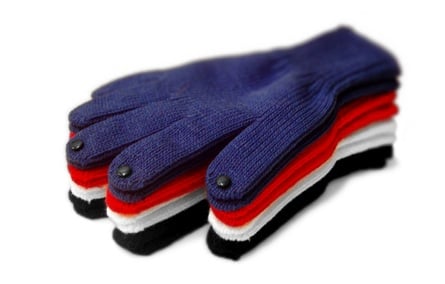
Those of you with iPhones or other touch screen phones all know by now that gloves and touch screen technology are a problem.  In snowy Cleveland my outdoor phone conversations are always very quick and I do a lot of call screening to determine if I really want to take my glove off, take the call and let my hand freeze.

No more frigid fingers! Dots Gloves have come to the rescue.

Dots Gloves
Heavy duty Dots Gloves featuring conductive yarn dots on fingure tips.

 The gloves range from $15-$25 and allow you to perform basic iPhone functions such as answering a call, dialing, activating the iPod, etc.  The first gloves had little metal conductive dots on three fingers, but the new design features dots on the figures made from conductive yarn. 

Older version of Dots Gloves with metal dots on finger tips.
In an interview with the Daily News, Jeremy Horwitz, editor of iLounge, says a bare hand is still better than a Dots glove.  (Krafty thought: “Well Duh!”)  He says  “These tips are able to activate the key icon-sized features of the iPhone and iPod touch -turning on music, changing tracks, and adjusting volume – but offer too little precision for typing.” 

Who freaking cares!? I will update my Facebook and text when I am inside and warm, I just want to answer the phone without taking my glove off and freezing a hand.  Too bad they are pretty much sold out of every style and size.  I will just have add them to my mailing list or follow them on Twitter or Facebook because they say the new line is coming out February 2010 (hopefully that means it will be out any day now).

Paying for Online Content

Stephen Abramhighlighted the recent Nielsen Wire post, “Changing Models: A Global Perspective on Paying for Content Online”  and wondered what these results mean for libraries and our business models. 

I would add another component on to Stephen’s question, what does this mean for library vendors as well?  How does the public’s unwillingness to buy something online effect us and does that drive what we buy from vendors?

The bar graph while pretty doesn’t give a lot of detail.  Missing from the blog post and the report is consumers’ willingness to buy books online which is large emerging area.  At first glance most of the resources measured (theatrical movies, music, games, magazines, newspapers, etc.) are not exactly high on the list of medical library online collections. 

However if you dig deeper into the report  you come across a few interesting charts and bits of information (around pg 5).  Most consumers believe if they already subscribe to a newspaper, magazine, or other service then they should be able to use the content for free…AND do with it however they want. Sixty two percent of the consumers polled believed that once they purchased something, it should be theirs to copy or share with whomever they want.  (This makes me think that consumer’s minds on copyright and fair use may not be in line with the law due to their belief that they paid for it they can do whatever they want with it.)

Also interesting for online journal companies and book publishers, about half of those surveyed preferred micropayments for specific content.  In other words they don’t want to pay for the whole book they when they just need the chapter. 

Finally, while publishers and producers try to make a correlation between the quality of paid vs free online content, most consumers were pretty evenly split as to whether that is the case.  They question whether online content would really suffer if companies could not charge for it. 

As I mentioned, a lot of this information is directed at general news, information, and entertainment resources, so there aren’t any direct correlations to specifically medical resources and information.  But this is a look into the consumer’s mind, and while there might be some adjustments here and there due to the unique resources and content in medical libraries, I would be willing to bet this willingness or willingness to pay for access follows through to some degree.  So as the future shows us new ways to retrieve information, it shows us a new way society views entitlement.

Different Things at MLA 2010 Annual Meeting

Things will be a little different for MLA’s 2010 Annual Meeting and it all centers around keeping members connected.

MLA President Connie Schardt’s email to Medlib-l and her post on MLA Connections, discusses our Keynote Speaker, Daniel Pink author of “A Whole New Mind: Why Right-Brainers Will Rule the Future.” She describes the book as a “ground breaking guide to surviving, thriving, and finding meaning in an outsourced, automated, upside down world.”

As Connie mentions, Pink is a little outside of the box for MLA Keynote speakers, because “for the first time, the National Program Committee has selected a common book.”  Additionally, Pink wants to try to connect with us (the target audience for his keynote speech) before, during and after the meeting. Specifically he wants to hear from us BEFORE his talk so he can “frame his presentation within our context.” So take a few minutes and go to Dan Pink’s invitation to MLA ’10  and share what you would like to discussed at the conference.  Several librarians have already shared ideas, and you can browse through them and share your own. 

Another change to MLA is connectivity.  This meeting will be more online allowing for more people to attend virtually and view things remotely.  This is the first time the annual meeting will have an online conference community portal.  According to Eric Schnell who will be helping out with coordinating the portal, “conference community is an online experience being built around MLA 2010 that allows attendees (both in person or virtual) to interact and share through various online social tools. Some of the content on the site will even be made available for association members that are not attending the conference.”

In the past we have used many of these online social tools but now MLA is pulling them together, adding new owns, and making them part of a cohesive conference community portal.  One of the things that will be in the portal will be  Daniel Pink’s presentation.  It will be videotaped and available within 24 hours.

Several weeks AFTER the conference Pink will participate in a live Webcast to continue the discussion and reflect on how we might apply things in our libraries.  (I am not sure if this will be in the portal or if we will link to it through the portal.)

What else is going to be in the portal?  Well I am sure the MLA portal people (like Eric) and the NPC have ideas, but they are looking to hear from you  to learn about what you think should be in the portal or what other neat online conference-ish things have been done elsewhere that might work in the MLA ’10 portal. 

Some neat new firsts for MLA for the annual meeting.  This is one giant leap toward connecting with members.  Hopefully members will take the opportunity to connect with each other and with MLA because this the only way we can make the organization more relevant and work best for members.  So reach out and connect.