Wondering what will be presented at the meeting? Check out the preliminary program (now available) to check out the plenary speakers, CE courses, various events, and the concurrent program sessions.
Finally, make sure you are keeping up with all MLA’13 news by subscribing to the blog http://npc.mlanet.org/mla13/. You can either subscribe to it via RSS or via email (bottom right).
Sigh…. I hate ebooks. I really do. Dealing with ebooks is worse than refinancing your home loan. Yeah the home loan has a ton of paperwork and dives into your private financial life, but the hoops you have jump through for ebooks makes me want to repeatedly bang my head on my desk. (I’d bang it against my iPad but that cost too much to replace from repeated bangings.)
The article “Why you should avoid iBooks for your medical ebooks” on iMedicalApps is just another example of the frustration having to do with ebooks. My major criticism about the post is that it isn’t news. I mean really, is it a shocker that you can’t get your iBook somewhere other than your Apple device? Does music and iTunes ring a bell to anyone? This problem really isn’t unique to Apple and iBooks. What makes iBooks unique is that it doesn’t have an app that pretends to allow it to be read on another device. You can’t download an iBook to an Android, Kindle, or Nook. While that may be frustrating, at least most people should know that going in, which isn’t always the case with Kindle or Nook books.
First off… Downloadable ebooks are device dependent. Don’t tell me that you can get a Kindle book on an iPad so Kindle books aren’t device dependent. Pthbb. I have the Kindle app on my iPad and there have been several times where I have wanted to read a Kindle book only to learn that certain Kindle book requires me to download it first to a USB or to my Kindle device. Gee thanks, for making it a pain to get it on my iPad.
All (with the exception of iBook) ebook platforms have free apps for reading their books on your “different” device. But it isn’t always a simple to download and read the book as the cool television commercials or the apps claim. It is a pain in the butt.
If you get ebooks through your local public library the process can still be confusing. Overdrive, a “leading full-service digital distributor of eBooks, audiobooks, and other digital content,” enables libraries and schools to provide downloadable books to their clients. They have an app for downloading and reading books. Supposedly this app makes it easier for people to download and read an ebook regardless of the ebook format and their device. All I have to say about the Overdrive app is that it is still confusing to the average user. I am a librarian for God’s sake and I find it confusing at times.
If you aren’t a public library, you might consider Mathews ebrary to offer downloadable ebooks. However their platform is confusing and clunky, it is difficult to even find the title you want to download. It doesn’t matter what titles they have if they are difficult to find. I don’t know how easy it is to download the ebooks to your device because we never made it that far.
See where I am going here? I don’t care if you have a Kindle, Nook, iPad, etc. I guarantee you that there will be a time when the title you want is only available in a format different from your device. If you buy direct from Amazon, Barnes and Noble or Apple, you run the risk that the book won’t work on your “different” device despite having the app. Equally frustrating is that the “all in one” ebook reader services such as Overdrive and ebrary are confusing from the design side of things and confusing from the download side of things because they are dealing with ALL ebook types and devices.
Next…. Institutional subscriptions to ebooks, specifically medical, may not be device dependent but they aren’t the answer either. This is somewhat related to ebook format and platform problems but like all things bought at an institutional level, the problems are different.
UnBound Medicine and Inkling are companies that provide access to download ebooks to institutional users. While it is fairly easy, their titles are limited and can be quite expensive as some charge as if you are buying an individual copy for every person.
Other ways institutions get their ebooks are through publisher electronic site packages. These aren’t downloadable ebooks. You can’t highlight a paragraph or take notes on the ebook because they all live on the web and you are accessing them through your wifi or cellular connection. These are books within MDConsult/ClinicalKey, AccessMedicine, Ovid/LWW, Wiley, Springer, Rittenhouse, EBSCO etc. While these books aren’t device dependent they are just as much of pain, but for different reasons.
They are all in their own publisher created silos so searching their full text is difficult if your library doesn’t have a discovery tool. Even if your library has a discovery tool, ease of searching depends on the discovery tool’s set up and your resources’ set up.
Users are unable to take notes on these book “pages” and at the same users are looking at these sites trying to find the downloadable version. They now are expecting books to be downloadable. They see it online and that is nice but then they ask how they can get that same book downloaded to their iPad or Kindle. Short answer, you can’t. Long answer…publishers either don’t want to do it or don’t have infrastructure to do it. Theoretically Ovid or Springer could partner with Overdrive to get their books downloadable. But I’m sure there is more to it than just partnering like that. I’m not sure if they are only interested in creating their own site for downloadable books or if they just aren’t interested. ClinicalKey/MDConsult and AccessMedicine probably won’t do downloadable because their books are within their larger information database site. In other words those sites have more than just the ebooks, they offer videos, patient information, images, etc.
So you have these major barriers to using ebooks but you also have a group of people who despite the complications are interested in getting them. What I find most misleading about the iMedicalApps post is that it is directed only at Apple’s iBooks when the problems with ebooks is pervasive and really a pain across all devices. Quite frankly it is a miracle that users have stuck with trying to get ebooks this long. We are a society that finds waiting more than 20 seconds for an elevator too long, how long are we going to wait for publishers to get their act together on ebooks?
On Facebook Dean posted the link to Cooper the Library Dog (YouTube) and it is just simply too cute not do as a Friday Fun post. Cooper is a brown Shih Tzu who comes to the Harvard Medical School library on Tuesdays and Thursdays as a registered therapy dog. Cooper is in the catalog and can be checked out for 30 minutes by anyone with an Harvard ID. According to the librarian on the video, Cooper is quite popular because other people, not just those with the Harvard Medical School will go out of their way to the library to check him out.
If you haven’t heard about the Mayan civilzation’s calendar predicting the end of the world on December 21, 2012, then you have been living under a rock. Personally I believe the Mayans were on to something. Instead, I believe the end of the world will happen on January 1, 2013. Why?
As of January 1st NCBI will no longer support Internet Explorer 7 and all the hospitals that haven’t upgraded will begin to have problems searching PubMed. You can’t blame the Mayan’s for not warning us. I think they were pretty close to their prediction considering that browsers and the Internet were not known in AD 250. I just think all of the doomsday prophets just translated things wrong (wouldn’t be the first time that happened).
The end may not come as a big bang right on the New Year, but as NLM makes enhancements and changes to NCBI the people in the IE 7 hospitals will begin to have problems with PubMed. http://www.ncbi.nlm.nih.gov/guide/browsers
The compatibility issue is just going to continue on. The newly launched PubReader hasn’t even been tested on Internet Explorer and from the looks of the browser compatibilty chart they aren’t dilly dallying around with IE 8 or 9, if they design for Explorer they are going straight for IE 10. http://www.ncbi.nlm.nih.gov/pmc/about/pr-browsers/
Since PubReader was “designed particularly for enhancing the readability of PMC journal articles on tablet and other small screen devices,” the compatability for desktop and laptop browsers may not be an issue for a while.
But this brings up the issue of IT departments needing to update the browsers. Many librarians I have communicated with have expressed how getting IT to upgrade anything (including browsers) is a monumental task. Just from my average web browsing it seems to me that a lot of web sites are jumping from IE 7,8 to IE 10. Even more frustrating/interesting for hospital librarians is that there seems to a growing number of people not even designing for Explorer.
Knowing who is winning the browser wars is tricky and getting good data on browser market share really depends on the site that measures market share. Network World’s article “Browser battle: Chrome vs. Firefox vs. IE vs. Opera,” says “it’s difficult to say who’s on top in this four-way scrap. For one thing, different methods of measuring market share often provide very different numbers – while data from NetMarketshare.com shows IE in front with 54% of the market for October 2012, StatCounter gives a slight edge to Chrome, about 35% to 32%. W3Schools’ information paints another picture again, showing a big lead for Chrome (44%) over about 32% for Firefox and just 16% for IE.”
It may just be me and my apocalyptic Mayan frome of mind but I am thinking of the Thunderdome for browsers. Although saying “Four browser enter, one browser leaves” isn’t as cool as Tina Turner’s line, “Two men enter, one man leaves.”
Basically with the amount of browsers vying for for top spot it makes it difficult for us and IT to keep up. So it is easy to see how people can be in this predicament. So instead of stocking up on food and water in anticipation of the end of the world, start working on your IT department to upgrade your browsers.
The most recent issue of Nurse Author & Editor Newsletter, December 2012, “Editors Cannot Know (and Sometimes Even Find!) It All: Making a Case for a Medical Librarian on Your Editorial Board” (requires subscription to read) by Judith S. Young and Tina M. Marrelli is an interesting case for having a medical librarian on the editorial board.
****** Full Disclosure:
I am currently on the editorial board for the Annals of Family Medicine and on the library advisory board for Silverchair (hosts several publishers), and I was on the Library Advisory Board of the New England Journal of Medicine. So I am kind of familiar with the role of a librarian on the board of a publication or publishers group.
******
Young and Marrelli describe the benefits having a medical librarian on the editorial board for a nursing journal.
“Working with a medical librarian and having access to this librarian as a sounding board is an untapped source of support for nursing journal editors– as well as authors, reviewers, and publishers. An experienced, professional medical librarian can bring value to a peer-reviewed journal and its nurse editor.”
The authors state that not only are medical librarians familiar with evidence based nursing but they can also serve editors as peer reviewers, verify international or unusual references, and conduct content specific search to see what extent certain topics are covered which is helpful for originality of journal content but also when compling subject specific issues.
As I mentioned, I have some experience being on various journal and publication boards and I think they are EXTREMELY helpful to both the organization as well as the librarian. I have learned more about the publishing side of things than I ever knew before. I also am able to experience their perspective on things such as what it takes to get a issue out and the part of the inner works of a journal from editors, advertising, peer review, market, web site demands, etc. I think the journals and the boards learned a lot from my presence on the board as well. In various board meetings I have been able to explain how their journal is primarily accessed by institutional users, web site issues/enhancements, budgets of libraries, and networking issues/opportunities. Recently I have been getting a lot of questions about the use of social media and how journals and publishers can use it effectively. For many on the boards, the idea of social media is something that they know is growing and is important but they don’t exactly have a concept of how they can use it because all they see about social media are Ashton Kutcher tweets.
So why am I posting this? Two reasons.
First: To inform librarians that there is another opportunity to get involved. Sure you have to be asked to be on a board, but if you are asked know that you have some good things to contribute. Keep your ears open and you will find your niche.
Second: To inform publishers and library vendors that don’t already have librarians on boards that we can be very helpful and provide a slightly different perspective on things. The worst thing to have on a board is a group of individuals who are all the same. You need people who use your product but who are a bit different from each other or have different strengths and backgrounds to compliment your board.
Librarians aren’t just in libraries. We actually do some things that can be helpful that is beyond the traditional library.
When I was co-chair of the MLA 12 annual meeting in Seattle, we solicited the membership for ideas and suggestions for programs, CE, speakers, etc. I am pretty confident in saying that Teresa and I were up for almost anything. We wanted it to be a fun but relevant meeting for people (the two are not exclusive).
The BIG thing to remember is that much of the annual meeting is planned WAY in advance. So if you are at the 2013 thinking of suggesting a speaker, CE, or program for the 2014 meeting…it is most likely too late. Those things have been decided and are being finalized. The jetway doors have closed and the plane is on the tarmac talking to the tower.
So that is why I am forwarding this request from MLA’14. If you don’t submit your ideas NOW you will have to wait to track down and give them to the 2015 NPC people.
Submit Ideas for MLA ’14 CE Courses and Symposia Now!
The MLA Continuing Education Committee (CEC) wants to hear from you! What new topics or courses have caught your eye? Who is teaching a class or has expertise you would like to tap into? What classes from past meetings would you like to see offered again? Are you currently a course instructor or would you like to create a new course? You may nominate yourself. MLA is accepting ideas for exciting and innovative courses and symposia to offer at MLA ’14 in Chicago, IL. Suggestions must be submitted by Friday, December 14, for consideration by the MLA CEC at its midwinter meeting. More information and forms are available on MLANET.
You only have a week to do it, so don’t hesitate. Every year I hear somebody who bemoans that MLA is only for this or that type of medical librarian. Or there weren’t any CEs and programs on certain topics. Part of me wants to turn around ask them if they suggested anything to the NPC ahead of time. Because if they didn’t, well then whose fault is it?
So stop being reactive, be proactive! Submit your ideas for MLA’14 now.
It has been almost 2 weeks since I wrote something on the blog. I appologize to readers. These last few weeks have been quite busy with kids stuff and holiday stuff that what little extra time I had got sucked into a vortex. I do plan on blogging very shortly. But I thought I would take this time to solicit opinions and ideas about what you would like to see on this blog for 2013. Is there something I should focus on specifically? Or, is there a topic that I have beaten to death that you are tired of reading? Let me know! I write not only because I like to but also because I like communicating with you all.
For example would you like more:
Database/product reviews
Mobile stuff (in general I will leave medical app reviews to the folks at iMedicalApps, they already do a great job)
Trends in medical libraries
What is happening on the MLA Board
I know you are all familiar with my voice, but would you be interested in having guest posts every once and a while? I usually don’t do them, but I am not opposed to them either. Bigger question…Is my blog relevant still? Would you rather get my insights from Twitter, Facebook or something else? Basically is this blog dead to you and I should focus on other things.
I look forward to any and all comments. Let me know. Without you, the reader, I would just be blogging to myself which isn’t much different than talking to myself and I do enough of that already.
Last Thursday the #medlibs group met on Twitter to discuss social media and medical libraries. As usual it was a fun and interesting discussion. We primarily discussed three areas of social media and medical libraries. The transcript can be found here.
Vendor Communication
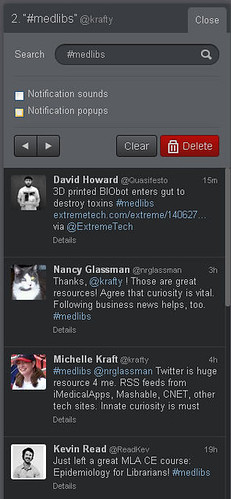
It should come as no surprise that companies monitor what is said about them on social media. What used to be a word of mouth activity, “Did you read that blog that blasted that company” has now become quite automated and much easier to find even brief mentions. Twitter is a perfect example. Personally, I have TweetDeck and HootSuite set up to look throughout the Twittersphere to find any tweets that say krafty. I want to know if anybody is asking a question, has an issue, or just how my re-tweets are represented. I also have those two programs looking for any tweets that mention the terms medlib, medlibs, or mlanet. The reason I have the term medlib or medlibs is because medical librarians often send out a tweet about medical library stuff by using the hashtag #medlibs. We are all human and we sometimes mistype it as medlib and there are always new people who don’t remember to use the hashtag, so my search filter catches those as well. You can do this for any number of words, people, hashtags, etc. It may sound complicated but it is extremely simple to do using either of those two Twitter programs.
So if I am doing it for my own personal reasons, you can bet your bottom dollar that library companies are doing it. It honestly is easier set Twitter to catch all of the tweets on a company’s name than it is to monitor Medlib-l for a company’s name. The reason, TweetDeck and Hootsuite automate it, and to my knowledge there is no automated way to monitor the listserv. As a result, a company like SpringShare is notified as soon as somebody tweets their name. If I mentioned SpringShare on MEDLIB-l either a company rep has to read the post or somebody has to forward it to them.
Here is what I am talking about:
TweetDeck searches for all instances of #medlibs and puts them into a seperate column for me to look at.
So companies like SpringShare can do something very similar to what I do (depending on their Twitter software) and instantly become aware of anybody talking about them. This results in fairly quick communication between twitterer and the vendor. For me it is often faster than when I have posted in MEDLIB-l
Don’t get me wrong, MEDLIB-l definitely has a purpose and Twitter can’t replace the longer discussions that happen there. However, if you are looking to state a quick question or comment such as “What is going on with Ovid Medline? @WKHealthOvid” or “Having problems with stats @SpringShare LibGuides, anybody else?” Twitter is an excellent way to get quick answers.
As with all companies, there are ones who “get it” and ones who don’t. Regardless of the method of communication; email, MEDLIB-l post, Twitter, Facebook, etc. there are companies that have poor communication skills or take every critique as an attack. As I mentioned, in my post “Embrace Your Critics,” there are some companies who don’t see criticism as an opportunity for growth and improvement. Yet there are other companies that are open to hearing from their customers. For the most part the same companies that I have encountered as open to hearing from people (good and bad about their product) on MEDLIB-l are also the same on Twitter.
Companies that have responded in positive ways to tweets directed at them:
NLM -Did not provide link because there are ton of different NLMs for different things. Often NLM librarians (not tweeting as NLM but as themselves) respond as well.
I follow A LOT of other companies, the above list are just ones I have had very good conversations with via Twitter regarding their product, services, etc. Note, I didn’t always lavish praise either. There were a few times where I complained about something not working correctly or suggested an improvement and still they responded in a very positive manner.
Patron Communication
Some librarians monitor their own library feeds and respond to patrons questions or provide information. Many on the list mentioned that their hospitals or institutions had people in marketing or PR who were monitoring the institution’s name. This area of discussion wasn’t explored as much as I think it could have been. Perhaps it is because this sub-topic often seems to creep into other #medlib discussions. I know @CarolinaFan1982 does a lot with Twitter and his School of Nursing users.
Professional/Personal Information Bleed
Finally the group ended with a discussion on whether there was a need to keep professional/personal divide when tweeting. I think it depends a lot on who is following you, what you primarily tweet on, and your institution. More and more institutions have social media policies so it is best to read through those and adhere to them.
For me, I let some of my personal life bleed into my professional life. So far it seems to be ok. If I decide to make the official split I can always have two accounts. One personal and one professional. I know several librarians who have two Twitter accounts.
I think it is also important how you respond to tweets. For example if I tweet:
@EagleDawg Great to see you on #medlibs chat
Only people who follow both me AND @EagleDawg will see that conversation.
BUT if you put an character, even a period at the beginning of the tweet then everyone can see that tweet.
Example:
.@EagleDawg How was the mocha milkshake?
or
#medlibs @EagleDawg How as the mocha milkshake?
Those two tweets can be seen by everyone. The #medlibs just ensures that the tweet can be seen by people following the #medlibs discussion. Knowing this information might be helpful regarding personal and professional tone within Twitter.
Overall
It was a very interesting and fun chat last Thursday. This Thursday is Thanksgiving, so there will be no #medlibs chat. We always welcome new people to the group, so feel free to join us November 29th. Twitter isn’t just wasting time, it can be used for professional communication and we who chat on Thursdays are the perfect example.
Plenty of doctors are switching mobile devices. I know the doctors at my institution are officially migrating from the Blackberry to the iPhone. Androids are not available as institutional devices at my institution, but that doesn’t mean that others don’t have them.
I documented my move from iPhone to Android and back to the iPhone in my “Friday Diary parts 1, 2, 3” and “An End to My Android and Virgin Mobile Experiment.” Personally, I didn’t like the Android as much as my iPhone. But I can see if you started out with an Android and went to the iPhone you might feel the opposite of what I felt.
In the latest installment of which is better, I thought I would list a few links to sites where people are trying one device over another.
iMedicalApps.com – Dr. Michael Kerr will be writing a series “A Doctors perspective of switching from iPhone to Android,” documenting his move from iPhone to Android and the medical perspective. They tried this once before with Iltifat Husain at iMedicalApps.com who said he would write more about medical apps on the Android from a physician’s perspective, but I haven’t found any further articles from Husain on this topic. Cross our fingers Kerr will have some interesting information.
Techlicious – “5 Things I Miss Most About Android” Suzanne Kantra details her switch from iPhone to Android, back to iPhone and realized she like the Android better.
My husband recently left is his Android and now has the Lumia 920 Windows phone. So he has used Apple, Android and now Windows. Perhaps I can get him to write a guest post about the differences and pros and cons of each device. For me I learned my lesson I am sticking with my iPhone, and according to ComputerWorld, I’m not alone in my platform loyalty.
**Update** The Krafty Husband thought it was a great idea to write about his experiences on each platform. So, look for a guest post from him sometime around Christmas.
Last week the #medlibs chat focused on disaster planning and @NLM_DIMRC (NLM’s Disaster Information Management Research Center) participated in the discussion. Disaster planning seemed to fall into 2 primary types, personal and professional. You need a personal disaster plan so that you and your family are safe. Once you are safe then you can deal with your professional disaster plan. In this case since it was the #medlibs chat most of the professional disaster plan stuff dealt with medical library disaster plans. The #medlibs chat transcripts can be found online.
Website? Check. Facebook page? Maybe… is it your library’s or your public relations department’s? What about Twitter? Are you using Twitter solely for your personal professional development (and fun)? As an automatic electronic news channel? Engaging with your users via their hashtag chats?
Come to the Thursday, November 15, 2012 #medlibs chat at 6pm Pacific/9 Eastern as we explore together how things are evolving for medical librarians and libraries in social media, including these chats!
Never participated in a Twitter hashtag chat before? Check out this overview and come on in, we’re a supportive community.
Believe it or not I use Twitter to communicate with medical librarians now more than I use the listserv MEDLIB-L. I get quicker responses from librarians AND library vendors. If I posted something on MEDLIB-L about a database flaw, it would often be several days before I heard from the vendor’s rep. However, when I tweet about it I get a response within a day (usually within a few hours). When the government was about to shut down I had a patron ask mewhat would happened to PubMed if the government shut down. I sent the question out to MEDLIB-L as well as Twitter. I got a response within an hour from somebody working at NLM via Twitter.
So if you are interested in discussing social media within libraries, join us tomorrow on Twitter.